
You are invited to join the Advisory Council for our 2021 statewide survey!
The DataHaven Community Wellbeing Survey completed live, in-depth interviews with 34,000 randomly-selected adults in every town in Connecticut in 2015, 2018, and 2020, producing robust local-level data on the issues most relevant to community well-being that are not available from any other public data source. This survey will be fielded again in 2021, with support from public and private partners throughout Connecticut.
Our Advisory Council is a critical element of this program. All public agencies, institutions, and community-based organizations in Connecticut are invited to join the Council and help us select topics to include in this year’s survey (there is no cost to join). Last year over 125 organizations participated. Please visit https://www.surveymonkey.com/r/2021DataHavenAdvisoryCouncil to register, provide initial feedback, and submit ideas. We encourage you to share this link with your agency or community partners, including advocacy organizations in your area. Responses are requested by noon on Thursday, February 11. The Advisory Council will be invited to provide additional comments and feedback on the survey design after that date.
New Resident-Led Documentary Films
In the latest installment in our Powering Healthy Lives video series (ctdatahaven.org/video), DataHaven and Purple States have worked with local partners to produce three resident-driven documentary films focusing on Hartford, New Haven, and the Lower Naugatuck Valley area of Connecticut. Check out the new documentaries below, and learn more about the project on our website.
- Hartford – Opioids and health disparities: Latinas: https://youtu.be/GFLnIQeEPRc
- New Haven – Heart disease and health disparities: Making healthy food affordable https://youtu.be/-qLa1H7V16E
- Valley – Heart disease and economic change: supporting healthy behaviors: https://youtu.be/_sHI–OGe38
View all of our video stories here.
New Data Stories
DataHaven Executive Director, Mark Abraham and colleagues in the CT Mirror: State must center health equity in Connecticut’s health information exchange
- “This pandemic has shown us the state needs to accelerate its work to create a full-fledged and operational health information exchange (HIE). It is more important than ever that we ground any health information system in the concerns of equity. Otherwise, we will never know what is really happening on the ground or in the streets, nor be able to construct policies that truly improve people’s lives in the places where they are most needed.” said Mark Abraham, Executive Director of DataHaven.
DataHaven Research Assistants, Aparna Nathan and Numi Katz in the CT Mirror: Eviction moratoriums not enough to protect family and child well-being
- “The new study shows we must restructure housing relief policy. Well before evictions are filed, housing insecurity has already had a devastating effect on child well-being. Interventions need to happen before that time.”
Congratulations to DataHaven Board Member Maritza Bond! https://www.newhavenindependent.org/index.php/archives/entry/maritza_bond_new_havener_of_the_year/
- Bond was recently honored as “New Havener of the Year”! Read more about her accolades in the New Haven Independent.
For more information, please contact Mark Abraham, Executive Director, DataHaven, info [at] ctdatahaven.org.
About DataHaven
DataHaven is a New Haven-based non-profit organization with a 25-year history of public service to Connecticut communities. Its mission is to empower people to create thriving communities by collecting and ensuring access to data on well-being, equity, and quality of life. Learn more at ctdatahaven.org.
An article in the New Haven Independent discusses DataHaven’s new mini-documentary on heart disease and lack of access to healthy foods in New Haven.
Read the article here.
New DataHaven survey provides reliable information to help Connecticut communities understand the impacts of COVID-19
Click here for the full announcement and survey results.
See news and broadcast coverage of survey results from the front pages of the Connecticut Mirror, Hartford Courant, and other outlets here.
In-depth interviews with over 1,100 randomly-selected residents reveal how daily experiences differ by age, gender, race, and geographic area
DataHaven released a comprehensive dataset and new analyses from the fourth wave of its DataHaven Community Wellbeing Survey (DCWS). Considered to be one of the largest community health and quality of life surveys in the United States, the DCWS has provided Connecticut with consistent statistics about health, economic security, and social issues since 2012, based on approximately 35,000 live, in-depth interviews conducted in partnership with the Siena College Research Institute.
The latest results, released today by DataHaven, are based on live interviews of 1,108 Connecticut adults conducted between July 27 and August 18, 2020. The DCWS provides reliable estimates for the state as well as for residents grouped by characteristics such as age, gender, race/ethnicity, income, and the “Five Connecticuts” town type. The program is unique due to its focus on Connecticut neighborhoods and range of questions within a single survey.
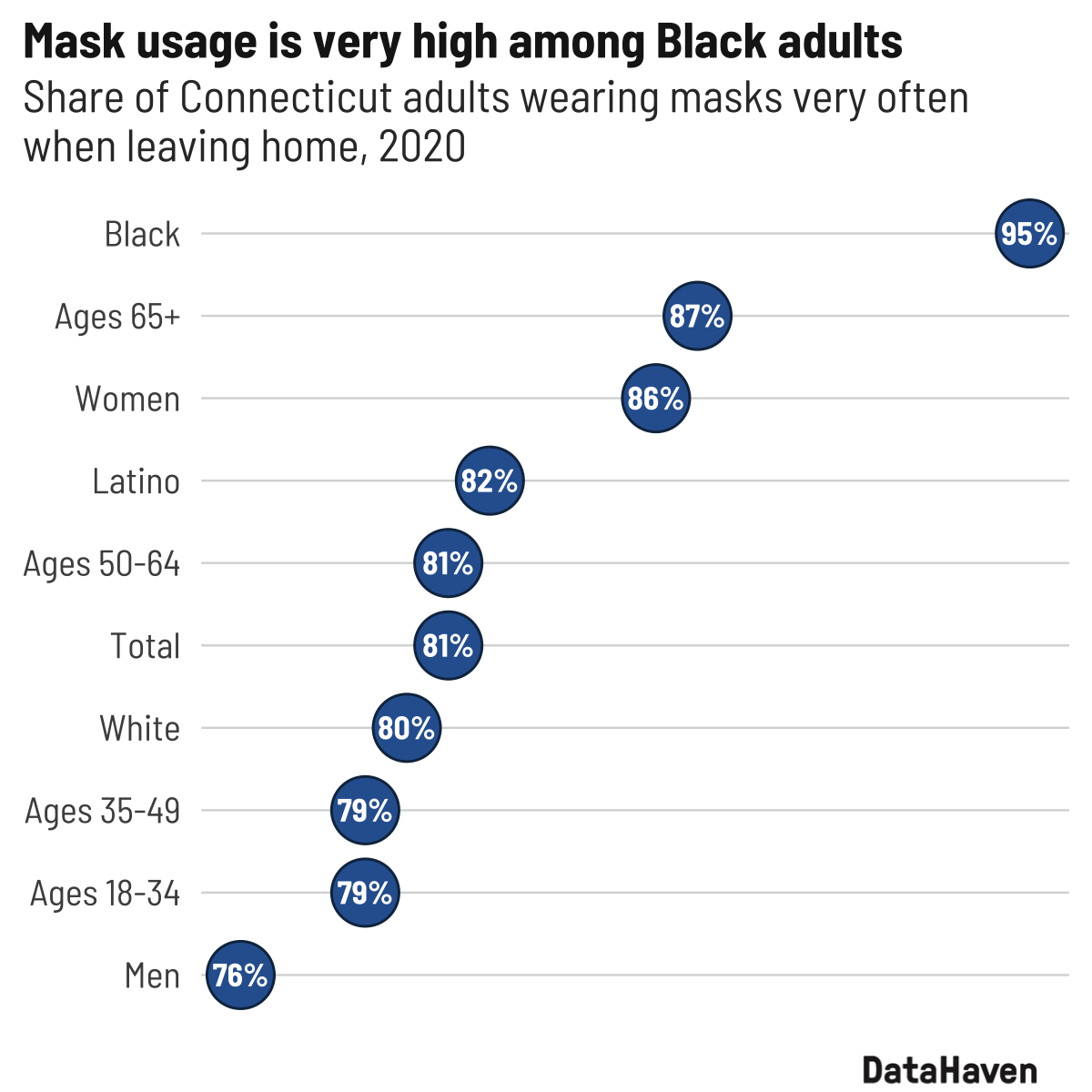
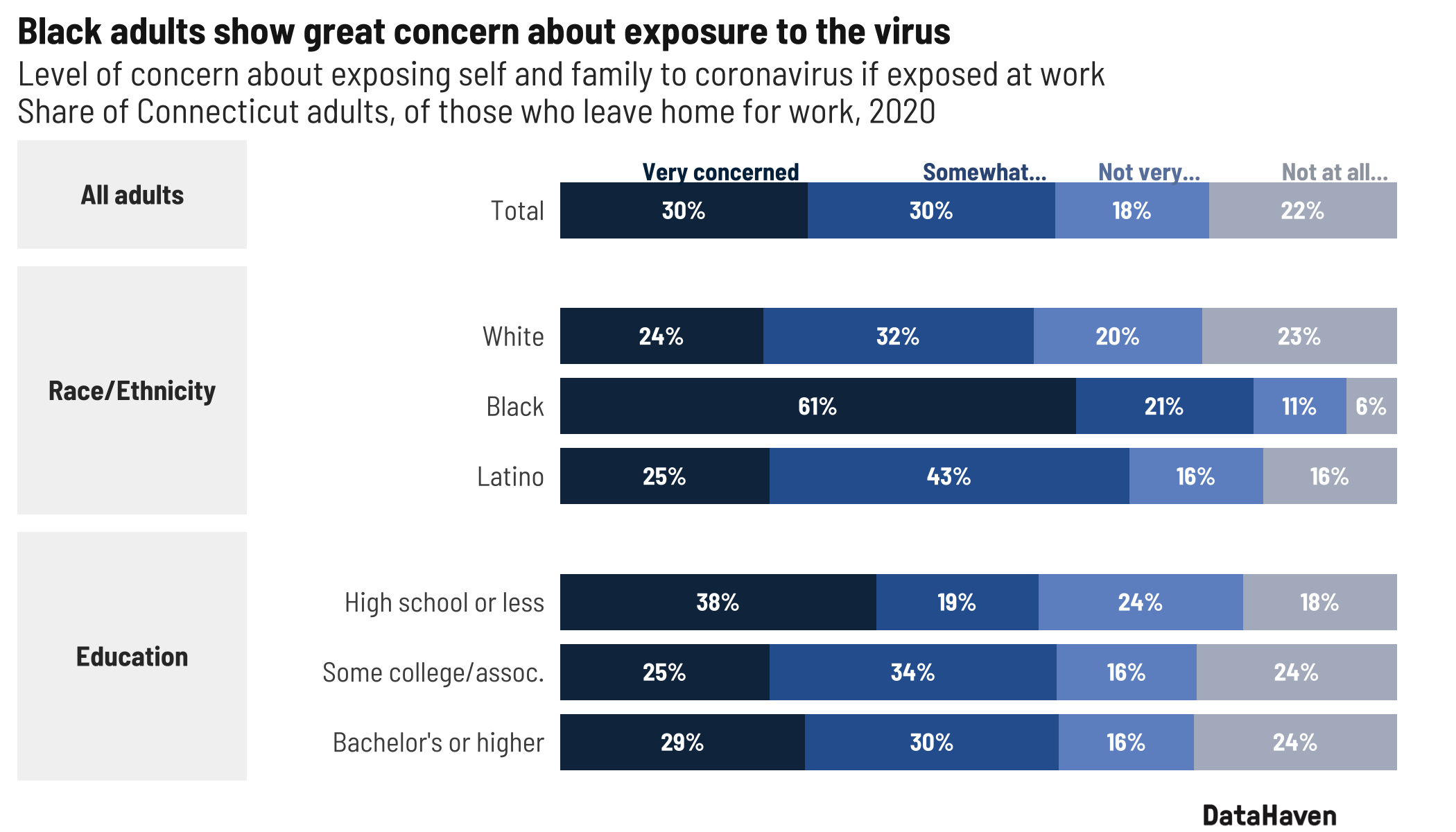
In response to the COVID-19 pandemic, the most recent wave of the DCWS included questions about social distancing, access to testing, vaccination, workplace safety, trust in institutions, and the impacts of the pandemic on residents’ health care and economic security.
Thank you to organizations that helped to fund this wave of the DataHaven Community Wellbeing Survey, including The Community Foundation for Greater New Haven, Tufts Health Plan Foundation, Connecticut Health Foundation, Hartford Foundation for Public Giving, United Way of Central and Northeastern Connecticut, Nuvance Health, City of Hartford, Trinity Health of New England, Valley Community Foundation, Greater Waterbury Health Partnership, BJM Solutions, and the Center for Research and Engagement at Yale School of Medicine!
More from DataHaven on this topic:
- Newly-updated interactive data tools, which statewide leaders are using to understand critical issues such as housing, food security, health care, and health outcomes at the neighborhood, legislative district, and regional levels, disaggregated by demographic group
- COVID-19 data analyses and infographics, created in response to requests from local partners
- Towards Health Equity in Connecticut: The Role of Social Inequality and the Impact of COVID-19, a comprehensive 47-page publication by the DataHaven team, released in June 2020
- COVID-19 Reckonings video series, produced by Purple States and DataHaven with residents of Connecticut communities hardest hit by the pandemic because of longstanding inequities
More statewide health and housing studies underway at DataHaven…
New Housing Study Announced
Fairfield County’s Center for Housing Opportunity Partners with Urban Institute and Local Organizations to Lead Statewide Study of Affordable and Accessible Housing in Connecticut
Fairfield County’s Center for Housing Opportunity (FCCHO) has announced a new collaborative project with local and national housing and data experts, including DataHaven, to deliver a statewide needs assessment of Connecticut’s affordable and accessible housing stock.
“This statewide study represents a significant step towards developing a data-driven understanding of housing, a topic that is more important than ever given the emerging research that associates housing conditions with the striking disparities in the impact of COVID-19 across Connecticut neighborhoods,” said Mark Abraham, Executive Director of DataHaven.
Health Equity Data Analytics team presents to Connecticut Office of Health Strategy Health Information Technology Council
On September 17, DataHaven Executive Director, Mark Abraham, presented a project update to the Council, along with colleagues from Health Equity Solutions and Yale University. The Health Equity Data Analytics project seeks to develop strategies and use cases for Connecticut’s evolving health information exchange (HIE) that can help drive progress towards better patient health outcomes at the population level. View the agenda, slides and other public meeting materials here on the CTOHS webpage.
Reduce the risks of reopening for Black and Latino workers
By Nathan Kim and Cynthia Farrar
The dilemma of reopening is often framed as a choice between public health and economic growth, between life and livelihood. But for families like Aziya’s, the trade-off is not so clearcut. Because of a long history of occupational segregation, working is riskier to their health, and the economic rewards are limited and insecure.
Aziya’s realistic assessment of their options opens the final episode of COVID-19 Reckonings, a video series produced by Purple States and DataHaven with residents of Connecticut communities where infection and death rates have been especially high due to long-standing social and economic inequities. In the economic as in other dimensions of the pandemic, an acute problem for white families is both more acute and chronic for Blacks and Latinos. As the title of the final episode suggests, they now face tougher choices.
For some workers, the reopening requires no trade-offs. According to the Economic Policy Institute, higher-wage workers are six times more likely to be able to work from home than lower-wage workers. And they are clustered in particular industries. A National Bureau of Economic Research working paper reports that 75 percent of finance, management, and education sector employees can work remotely, as compared to 4 percent of hotel and food service workers. In its recent health equity report, DataHaven draws on its analysis of the Census Bureau’s American Community Survey to show that workers who must either start or — as ‘pandemic-essential’ workers — continue going out to work are disproportionately people of color, while the workers who can work from home are disproportionately white.
Occupational segregation into certain industries means disproportionate risk of exposure. Black and Latino workers are more exposed to infections not just because they have to go out to work to support their families, but because they are overrepresented in particular sectors. A new study of 2019 national employment statistics by occupational risk factors finds that Black workers are over-represented not just among ‘essential’ workers in the sense used during the pandemic shut-down, but in all industries that involve close contact with other workers and the public.
The jobs of the people featured in COVID-19 Reckonings fit a cluster of Department of Labor/Occupational Information Network (O*NET) criteria that defined what we now call frontline work well before the pandemic: daily physical proximity, contact with others, and exposure to disease and infections. Jobs with these characteristics include the roles deemed ‘essential’ during the shutdown, and many others in sectors that are now reopening. Aziya’s godmother is a security guard; Tyrone is a chef; and Tank has been working throughout the pandemic, performing the ‘essential’ work of sanitation at a big-box grocery and retail store.
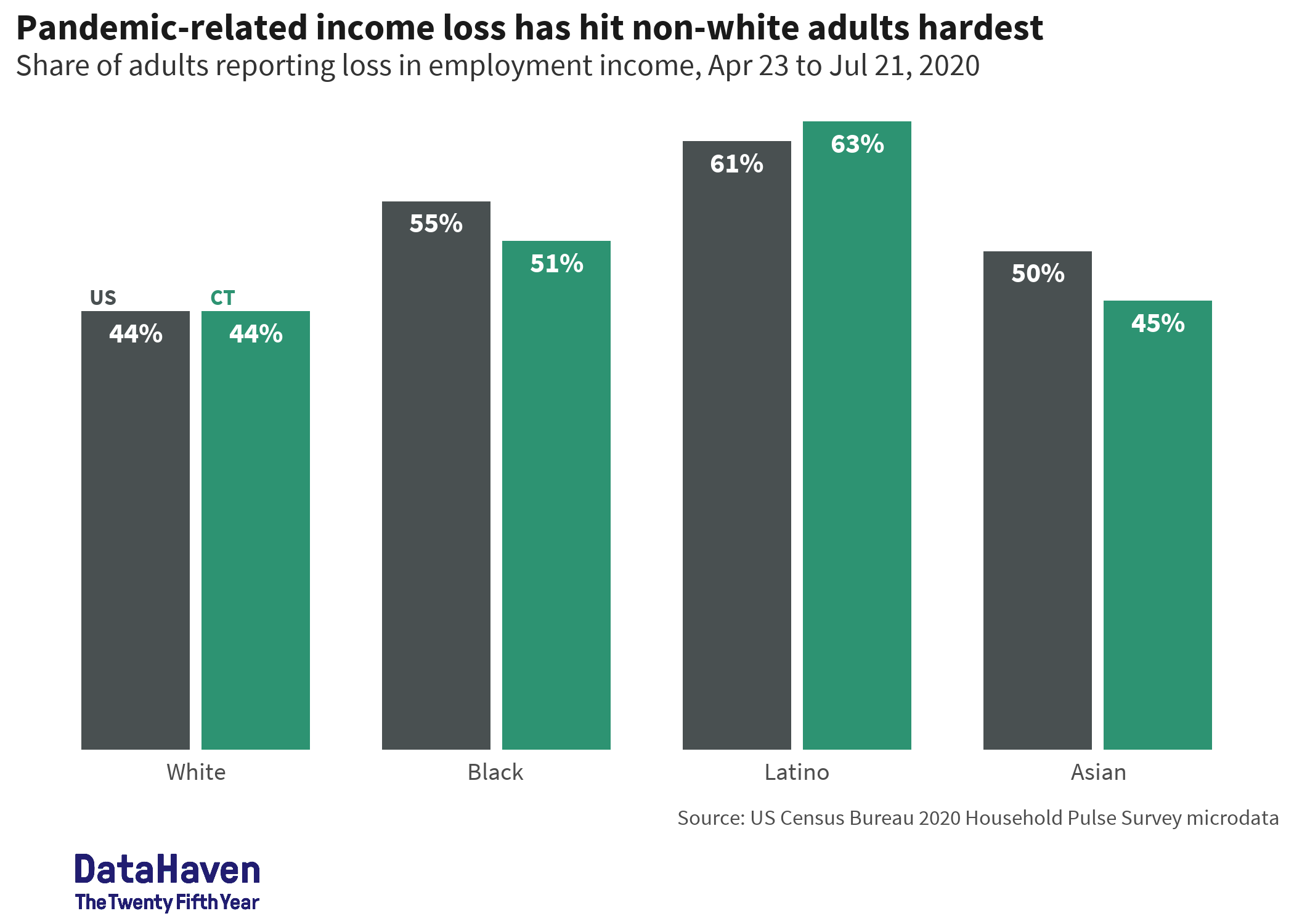
These workers face greater health risks because of the kind of work they do. But they are also more likely to lose their jobs. In Connecticut, Black and Latino workers have been hit hardest by the economic impact of the lockdown measures. According to DataHaven’s analysis of the U.S. Census Bureau’s Household Pulse Survey, 24 percent of Black workers in Connecticut reported a job loss during the pandemic compared to 11 percent of white workers. Additionally, 30 percent of white workers in Connecticut who stopped working said they were furloughed or laid off, or a business had closed, temporarily or permanently – as opposed to 48 percent of Black workers and 47 percent of Latino workers.
What happened during the shutdown is a sign of persistent job insecurity. Even before the pandemic, workers in these sectors have been more likely to lose their jobs. The DataHaven analysis cited above shows that industries at high-risk for job loss include retail, food service, and personal care — like beauty salons and barbershops.
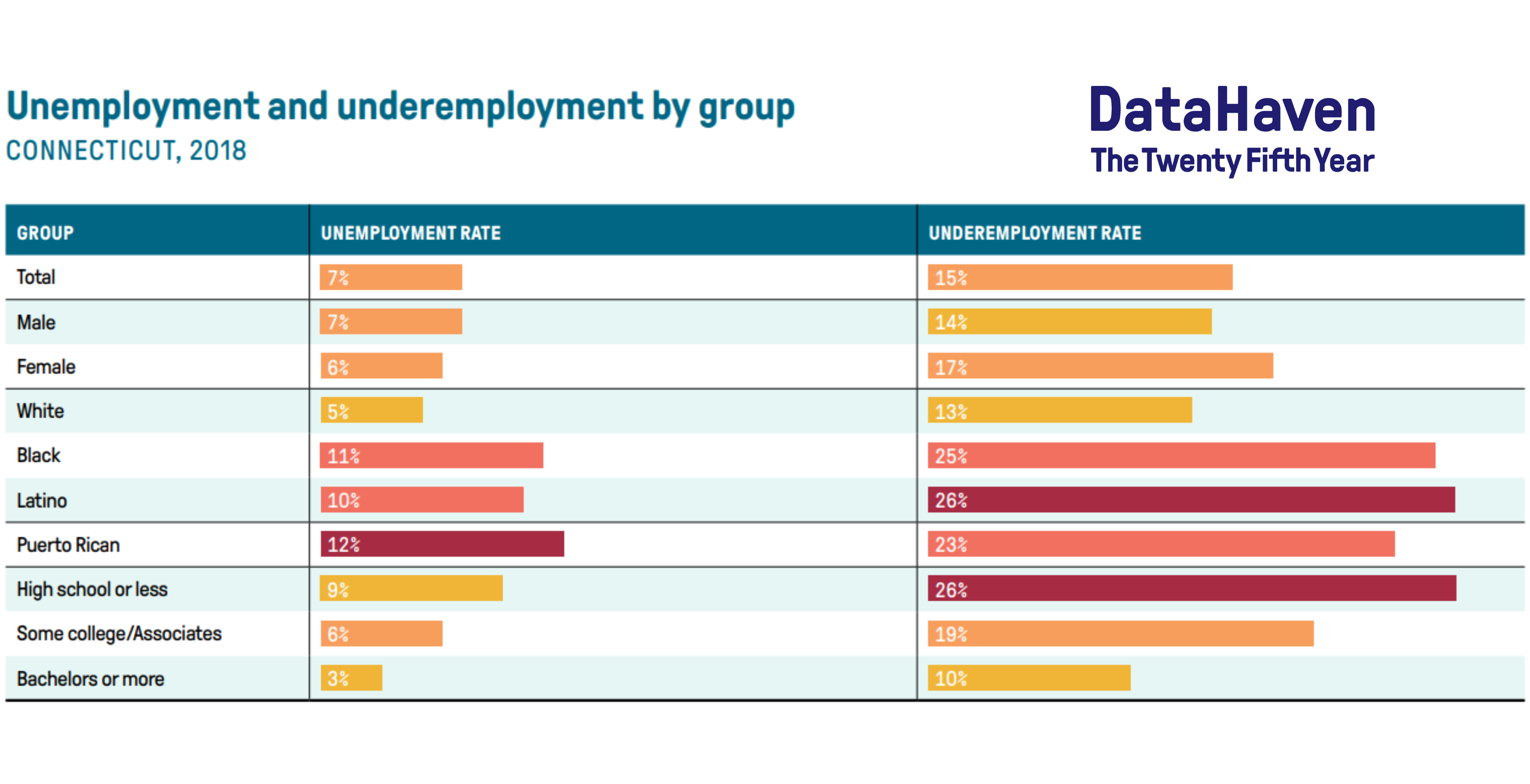
Persistent inequities in employment, income, and wealth have deepened the difficulties faced by people of color during the pandemic. Black and Latino workers in Connecticut were already twice as likely as white workers to be unemployed or underemployed. And Black and Latino households often have little or no financial cushion to buffer the consequences of a period of unemployment. National Census data shows that for every $100 of wealth held by whites, Black and Latino families possess only about $10. A Prosperity Now analysis of Census data from 2013 to 2017 estimated that 56 percent of households of color in Connecticut did not have enough wealth to cover basic expenses for three months if they lost their primary source of income. The same was true for only 19 percent of white households.
DataHaven analyses of surveys collected by the Census Bureau since March 13th confirm this picture. Without savings or assets to cushion against the worst effects of the shutdown, many residents have been unable to pay for even basic necessities. Black and Latino residents in Connecticut were over two and a half times more likely than white residents to be unsure of how to pay rent or mortgage during the pandemic, at 31 percent, 34 percent and 12 percent, respectively. In this same period, Black and Latino residents of Connecticut were also three times as likely as white residents to face food scarcity in their households, at 18 percent, 18 percent, and 6 percent.
Dismantling the entrenched racial inequities that have for so long restricted opportunity and heightened risk for Black and Latino residents of Connecticut will require structural reform. In the short term, rent moratoriums, stimulus checks, and more funding and flexibility for safety net programs can help residents meet their basic needs. Assistance to employers in securing protective gear (PPE) for everyone whose job involves proximity to others is crucial to protecting workers during the reopening. But the ways the individuals featured in Tougher Choices are responding to their quandary also point to two intermediate steps local and state stakeholders could take during the uncertain months ahead. During a time of gradual reopening and slow recovery from recession, these actions can help residents find a more sustainable solution to this double threat of health risk and economic insecurity.
Support entrepreneurship. Tyrone is trying to reimagine his career in a risky sector to create a viable and less-vulnerable business, and build intergenerational wealth. In New Haven, a local coalition that includes the Community Foundation and the City and an Economic Justice Fund started by ConnCAT are offering loans to make up for the federal government’s inadequate support for minority-owned businesses like Tyrone’s.
Protect municipal employment. In his search for a better, more secure job, Tank is applying to the City of Hartford. Government jobs have long been a ladder to opportunity. Yet city jobs are likely to shrink because the pandemic is already affecting tax revenues and expenditures, state and local, as the Connecticut Mirror recently reported.
In time, this crisis will recede for most residents of Connecticut. But the inequities it exposed and exacerbated will persist for Black and Latino families. In a June 2020 Washington Post/Ipsos poll, 83 percent of Black Americans said that controlling the virus is a higher priority than restarting the economy, compared to half of white Americans. In light of the experiences of the individuals featured in COVID-19 Reckonings, this is unsurprising. And not only because housing segregation increases the chances of infection; or because limited access to healthy food and high-quality health care raises the odds of serious complications. Without structural change in a variety of interlocking contexts, including housing segregation and the funding of education, Black and Latino residents will remain concentrated in jobs that jeopardize their health and won’t lead to financial security. This is not just a tougher choice — it’s no-win.
Nathan Kim is at DataHaven, a non-profit organization with a 25-year history of public service to Connecticut communities. Its mission is to empower people to create thriving communities by collecting and ensuring access to data on well-being, equity, and quality of life.
Cynthia Farrar is at Purple States, a video production company that brings the voices and stories of individuals affected by an issue into public discussion of what’s at stake and what should be done. Purple States has produced video for national news organizations and for a Connecticut news collaborative, the Cities Project.
New Data Stories: Staff Op-Eds Unpack COVID-19 Data and Health Inequities
Click here for our latest data stories.
Let the DataHaven staff unpack COVID-19 data and health inequity in our latest contributions to the Connecticut Mirror…
Food Insecurity:
Read Chloe Shawah’s article, “Pandemic highlights need for a renewed statewide focus on food sufficiency” by clicking here
Opioid Epidemic:
Read John Park’s article, “With over 1,000 Connecticut deaths last year, opioids demand even greater attention during the pandemic” by clicking here .
Housing and Homelessness:
Read Numi Katz’s article, “The fight for a more equal Connecticut begins at home: reimagining pandemic housing policy” by clicking here .
Health Equity:
Read Mark Abraham and Aparna Nathan’s article, “New data and resident stories must inform Connecticut’s roadmap for recovery” by clicking here .
Powering Healthy Lives: Video Series Highlights Residents for Health Equity
DataHaven and Purple States are producing a four-part series, COVID-19 Reckonings, with residents of Connecticut communities hardest hit by the pandemic because of long-standing inequities. You can watch the first three episodes below:
Episode One: “More Exposure”
Aziya Ricard and New Haven residents explain how COVID-19 puts CT’s most vulnerable communities at risk. Click here to watch.
You may also watch and share Episode One on Facebook, Twitter,and Instagram. (click each for direct links to the post).
Episode Two: “Deadlier”
Follow Wanda, as she discusses homelessness and housing insecurity during the pandemic. Click here to watch.
You may also watch and share Episode Two on Facebook and Instagram.
Episode Three: “Greater Harm During Shutdown”
This episode, we reconnect with Wanda to witness how COVID-19 has placed vulnerable residents at risk. Click hereto watch.
You may also watch and share Episode Three in a CT Mirror article with additional context, or on our social media feeds soon. Please help us share.
Learn more about this project by clicking here.
New Health Equity Report Informs COVID-19 Conversation:
ICYMI: Access our new Health Equity Report at http://ctdatahaven.org/healthequity.
CT Mirror:
“Study highlights worsening disparities amid COVID-19 pandemic”, Jenna Carlesso (7/6/2020)
https://www.ctdatahaven.org/blog/study-highlights-worsening-disparities-amid-covid-19-pandemic
Connecticut Post:
“Coronavirus more deadly for Blacks and Hispanics, exposes inequity”, Bill Cummings (6/26/2020)
https://ctdatahaven.org/blog/coronavirus-more-deadly-blacks-and-hispanics-exposes-inequity
Hartford Courant:
“Racial disparities persist in Connecticut’s COVID-19 outbreak, prompting concern about effects of potential second wave”, Alex Putterman (7/13/2020)
WNHH Community Radio:
DataHaven’s Kelly Davila Interviewed by Babz Rawls-Ivy (6/26/2020)
Learn more about the HER by clicking here.
Coming Soon
Roundtable discussion on housing and health equity: Join DataHaven and Desegregate CT for a conversation between legislators, advocates, and community members to discuss housing policy reform.
Statewide COVID-19 rapid-response survey: Thanks to support from our statewide partners and sponsors, DataHaven will be fielding a special wave of its Community Wellbeing Survey this summer. The survey conducts in-depth, live interviews with thousands of randomly-selected adults to measure changes in the health, well-being, and financial security of Connecticut.
COVID-19 Dashboard
Stay up to date with our COVID-19 Dashboard (here: https://www.ctdatahaven.org/reports/covid-19-connecticut-data-analysis).
We are excited to share “new” features:
Test Positivity Rates:
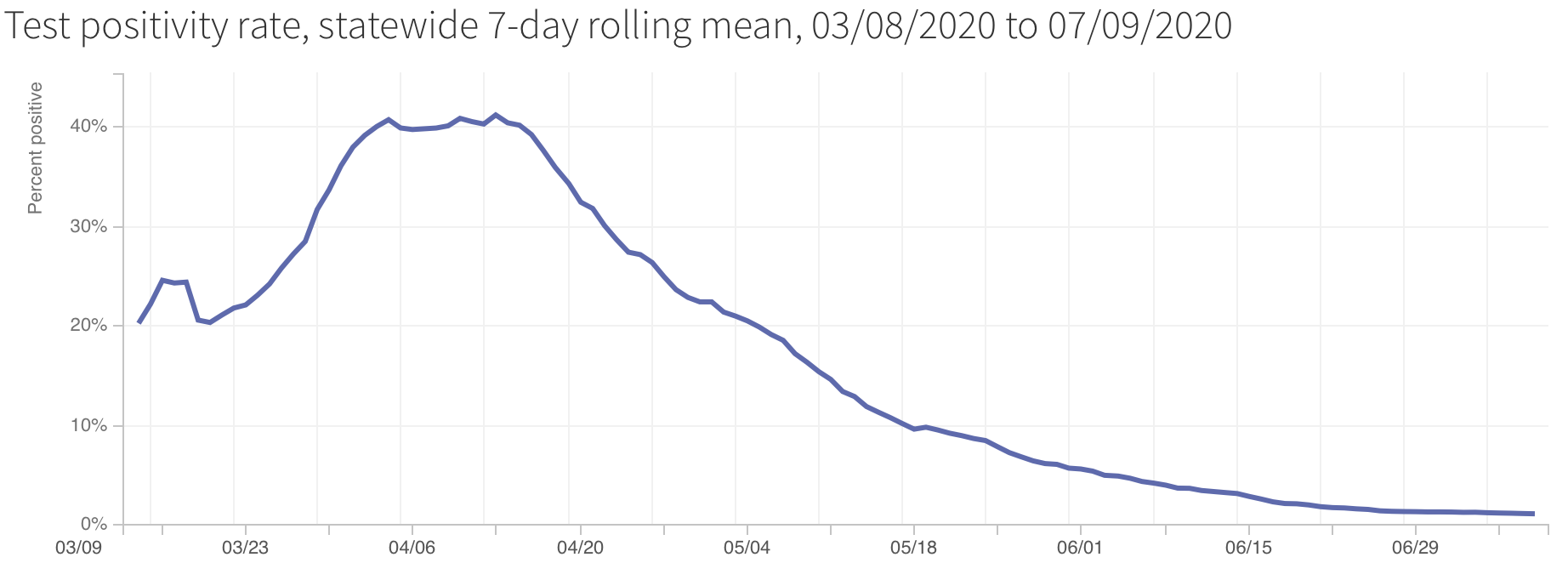
Track test positivity rates, or the percentage of tests administered that come back positive, as CT aims to have a positivity rate as low as possible per WHO recommendations.
Mobility Charts:
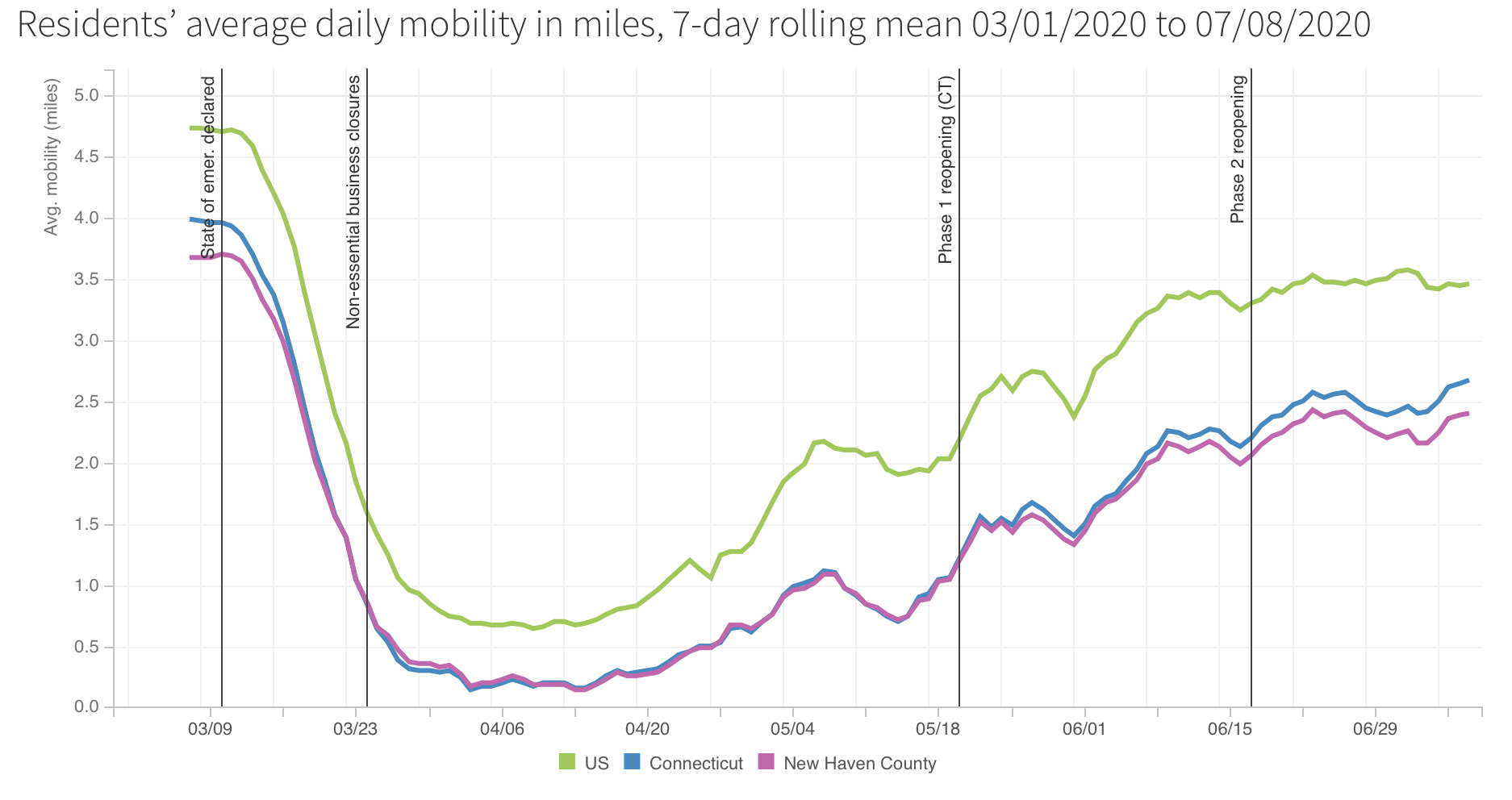
As the state eases restrictions of travel and movement, CT residents increase their average daily mobility.
Get to know our other “new” features (economic impact data, hospital change in total number hospitalized per day, and more) by clicking here!