
So far this month, DataHaven has published four new reports covering some of the most urgent issues facing Connecticut: housing, homelessness, disability rights, and behavioral health. Plus, scroll down to learn about how you can join DataHaven staff at our Data Office Hours events from March 4 to April 1 in Hartford, Middletown, New Haven, New London, Norwalk, and virtually.
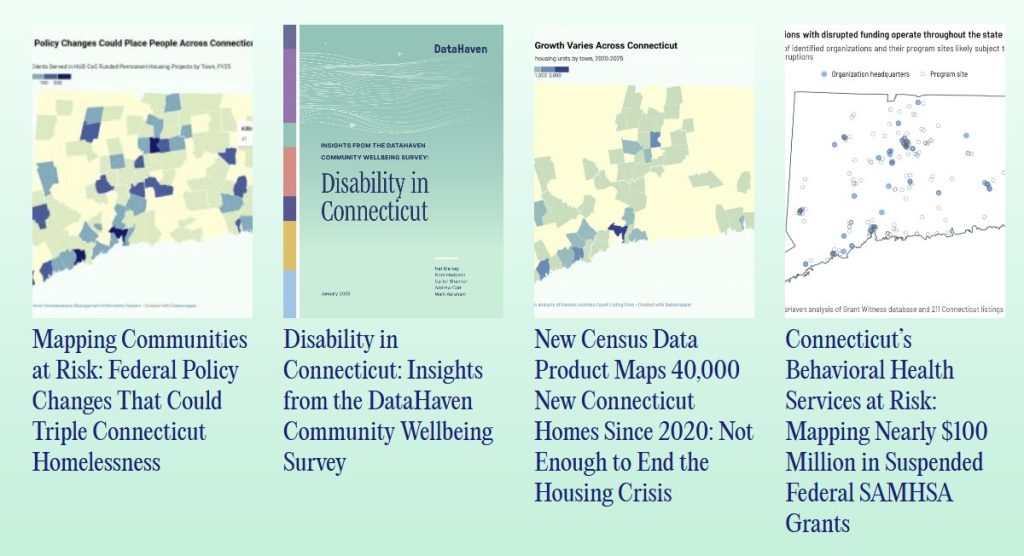
Four new reports from DataHaven
Mapping Communities at Risk: Federal Policy Changes That Could Triple CT Homelessness
Homelessness in Connecticut has risen every year since 2021 — and a recent federal policy shift threatened to make it dramatically worse. This new report, co-published with United Way of Connecticut, the CT Coalition to End Homelessness, and Advancing Connecticut Together, highlights that more than 6,000 residents in permanent supportive housing have been at risk of losing their homes under proposed federal policy changes. Whether you’re a policymaker, advocate, service provider, or concerned neighbor, this report maps the risk at the state legislative district and town level, provides background on the root causes of homelessness, and outlines the policy solutions that can prevent a crisis.
Disability in Connecticut: Insights from the DataHaven Community Wellbeing Survey
This new report, produced with guidance from advocates across the state, draws on DataHaven’s Community Wellbeing Survey to examine how disability affects people’s lives in Connecticut. If you work in healthcare, social services, housing, or community advocacy, this report provides essential local data that was previously not available from any other source on a population whose needs are frequently undercounted.
New Census Data Product Maps 40,000 New Connecticut Homes Since 2020
Connecticut ranks last in the nation in active housing listings per household and has a need for up to 400,000 new homes. This DataHaven report uses newly-released Census Address Count data — potentially a more accurate tool than traditional building permit surveys — to map exactly where housing supply has grown (and not grown) across all 169 Connecticut towns since 2020. New Haven and Stamford led the net increase in new units, and production accelerated from 2023 to 2025, but even at this current rate, it could take decades to meet the need. With interactive town-level and neighborhood-level maps and downloadable data, this is the most precise picture yet of Connecticut’s housing production gap. See why our community partners have been recommending it to anyone working on housing policy, zoning reform, or town planning.
On January 13, 2026, over 1,700 organizations nationwide received sudden termination notices for federal grants, likely including about $100 million in grants to organizations in Connecticut. The suspension of these grants threatened substance use and mental health services that communities depend on. This new report and accompanying maps give advocates, legislators, and providers the data to understand what’s at stake.
Data Office Hours
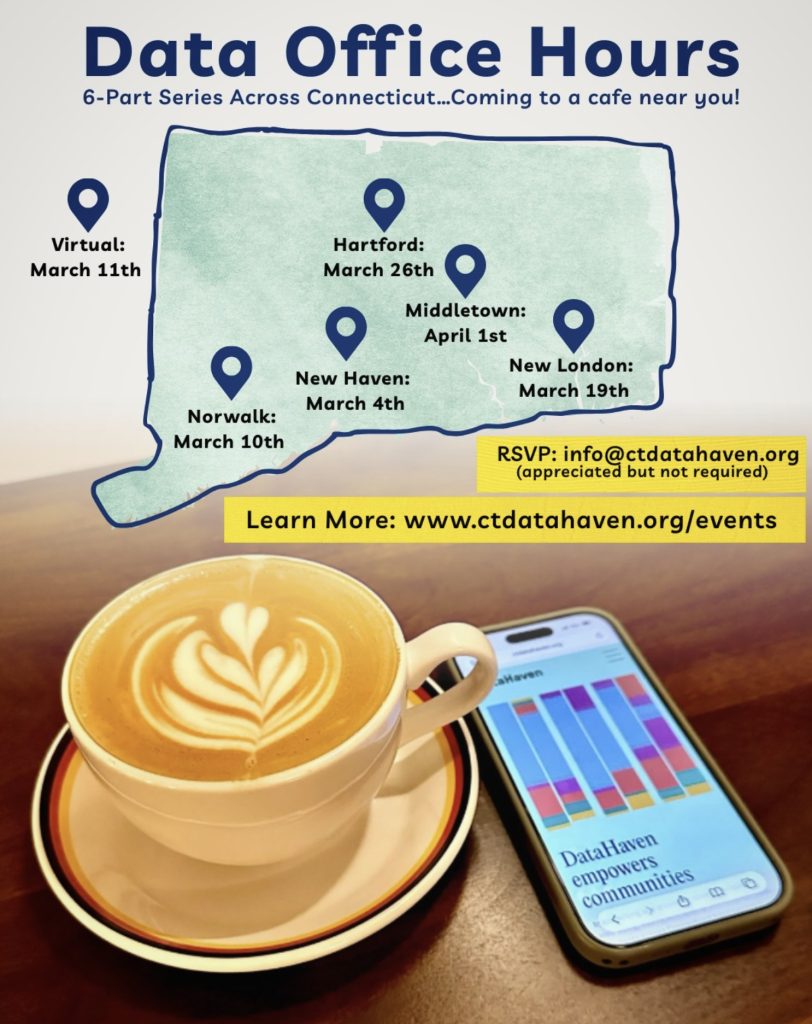
DataHaven is excited to announce Data Office Hours, coming to a cafe near you in Hartford, Middletown, New Haven, New London, and Norwalk, as well as virtually!
Do you have a question about the best ways to find or use data on behalf of your organization? A project you are looking to talk about with data-loving colleagues? Interested in brainstorming or troubleshooting with a data expert? Not sure where to start?
Data Office Hours are open to data enthusiasts of ALL levels of skill and experience and are designed to provide a casual and comfortable space to chat with DataHaven staff over a warm beverage or tasty treat. Come 30 minutes early (where noted in the schedule) to join for a mini data visualization workshop, and stay to connect with DataHaven staff about your data questions. Whether you are looking for technical assistance, a thought partner, or a safe space to get started, Data Office Hours are for you!
An RSVP is appreciated, but not required (except for the virtual session). Please email info [at] ctdatahaven.org to RSVP.
New Haven: Wednesday, March 4, 2026
Location: Book Trader Cafe
Mini Data Visualization Workshop: 11:00am-11:30am
Office Hours: 11:30am-1:00pm
Norwalk: Tuesday, March 10, 2026
Location: Carpe Diem Cafe
Office Hours: 12:00-1:30pm
Virtual: Wednesday, March 11, 2026
Please RSVP to info [at] ctdatahaven.org. Attendees will receive an email with the Zoom link.
Mini Data Visualization Workshop: 4:30-5:00pm
Office Hours: 5:00-6:30pm
New London: Thursday, March 19, 2026
Location: Washington Street Coffee House
Office Hours: 12:30-2:00pm
Hartford: Thursday, March 26, 2026
Location: Story and Soil Coffee
Office Hours: 10:00-11:30am
Middletown: Wednesday, April 1, 2026
Location: Klekolo World Coffee
Office Hours: 2:00-3:30pm
[Excerpt from news coverage by Sasha Allen and Ginny Monk, Connecticut Mirror, 2/27/26]
Homelessness in Connecticut is on the rise, but attempts to change federal housing policy leave the future of critical funding uncertain.
In Connecticut, homelessness has increased steadily over the past four years, according to Connecticut point in time homelessness count data. A recent report from DataHaven, a state-wide data organization, analyzed the potential impact from attempted federal policy change as well as future funding instability on an already growing population.
In November, the U.S. Department of Housing and Urban Development attempted to shift funding away from the Continuum of Care budget, jeopardizing permanent supportive housing programs in the nation. While a court order halted the funding shift, the change would have impacted more than 6,000 Connecticut residents, and the state would have lost up to $98 million annually in homelessness response funding.
Continuums of care coordinate regional systems that serve the unhoused population. Funding flows from HUD to service providers either through these continuums or the state government. Gov. Ned Lamont in December announced that he’d allocate $5.2 million of his emergency fund, approved by the legislature, to help the continuums of care after federal cuts.
In Connecticut, there are thousands of residents relying on this permanent housing all across the state. The programs typically serve people who were formerly homeless by offering them a place to live. Much of this support goes to people with disabilities who need ongoing services in addition to housing.
The Trump administration has indicated that it will continue trying to change the way federal housing dollars are spent, and the DataHaven report looks at the potential results if that were to happen.
For years, HUD has favored a “Housing First” approach to homelessness, meaning that other problems can be more easily addressed once someone has housing. The Trump administration has taken a different approach, saying in November that the approach fails to address “the root causes of homelessness, including illicit drugs and mental illness.”
But national research has tied increased rates of homelessness more to increased housing costs and a lack of available housing than substance abuse or mental illness.
The DataHaven report supports those findings.
During a Housing Committee public hearing on Tuesday, homelessness service providers referenced the DataHaven report as they testified on a bill that would ban landlords from requiring more than one month’s rent as a security deposit.
Sarah Fox, chief executive officer of the Connecticut Coalition to End Homelessness, said in her written testimony that the barriers to housing are too high for many people.
“That is prevention in plain language: when the front door to housing is too expensive, instability grows, and our homelessness response system becomes the backstop,” Fox said.
[Excerpt from news article by Nellie Kenney, 2/3/26]
As state legislators prepare to descend on Hartford for the 2026 legislative session, which begins on Wednesday, federal funding cuts are top of mind.
Connecticut Gov. Ned Lamont submitted a plan to the Connecticut General Assembly to offset funding cuts by dipping into the state’s new Emergency State Response Reserve, the governor announced in a press release on Thursday. Legislators will discuss extending the emergency response fund, which was originally intended to expire this month, at the first meeting of this year’s legislative session, according to New Haven Rep. Roland Lemar. [….]
Cuts will hit low income New Haveners particularly hard. A recent study by DataHaven projected that the cuts in President Donald Trump’s One Big Beautiful Bill Act to the Supplemental Nutrition Assistance Program, Medicaid and other federal programs will result in the bottom 25 percent of New Haven income earners spending $1,100 more a year on average.
That makes it the town in Connecticut with the fourth highest projected uptick in costs for that demographic. The middle 50 percent of households will receive $500 and the top 25 percent of households will receive $6,200 in tax relief on average, according to the study.
Lamont’s plan would allocate $18.7 million of the $332 million remaining in the reserve to “support items necessary for food and nutrition assistance, Medicaid assistance, youth mental health services in schools, and children’s wraparound services,” according to his press release. [….]
[Excerpt from news article by Sasha Allen and Katy Golvala, 1/27/26]
For months, Patricia hasn’t slept through the night. She’s stopped visiting friends, she no longer goes to the gym or the park, and she’s gained 60 pounds since immigration enforcement ramped up in the past year.
Patricia moved to the U.S. from Mexico 18 years ago and built a life as an active member of her community in Connecticut. But today, the only time she leaves her house is to work for a few hours each weekend, cleaning offices.
[….]
Across Connecticut, residents who fear they or a loved one may be deported are self-isolating and facing mounting mental and physical health consequences as a result.
A survey from DataHaven released in October found nearly a third of Connecticut residents worry “a lot” or “some” that either they or someone close to them could be deported, detained or have their legal immigration status revoked. That concern is significantly higher among Latino residents, 44% of whom reported such fears.
Anxiety surrounding potential immigration enforcement measures is leading some people to skip medical appointments, lose sleep and opt out of social activities — all of which, physicians say, damages mental and physical health.
Researchers at DataHaven found that, of the Connecticut residents who fear immigration enforcement, 14% have avoided medical care or know someone who has.
Camila Bortolleto is a steering committee member for HUSKY for Immigrants, a group that advocates to expand state-sponsored health coverage for residents regardless of immigration status. She said many immigrants are fearful that ICE will show up at their doctor’s appointment, or that they will get in trouble if they seek health care.
“We’re seeing a lot of folks who are very scared to seek medical care,” Bortolleto said. “They ‘tough it out’ until it gets so bad that they need urgent medical care. At that point, it’s much, much worse, health-wise. It’s also much more expensive by that point.”
Research finds this is a general trend influenced by immigration enforcement increases or policy change. Atheendar Venkataramani, a clinician, researcher and professor at the University of Pennsylvania, contributed to a study in 2021 that found that increased immigration enforcement correlated with a reduction in Hispanic individuals seeking health care.
“On average, what we found was that there was less health care seeking, even among people with chronic conditions who we would expect to see their doctor relatively frequently,” Venkataramani said. “Ours is one study, but there are tons of studies that link immigration enforcement with health care seeking and health care outcomes.”
[….]
The DataHaven survey found that more than half of Connecticut residents who fear immigration enforcement report increased stress or anxiety. And of residents fearing enforcement, around 20% report avoiding public settings, like school and work, or reported problems eating and sleeping.
Venkataramani agreed with Shader, saying that mental health is likely the aspect of health that “shifts most exquisitely” with immigration policy and enforcement changes. He’s seen these changes first-hand in his own patients who are immigrants.
“They’ll screen positive for depression and anxiety. They will come in with elevated heart rate, possibly elevated blood pressure,” Venkataramani said. “They’re very circumspect to share what’s going on.”
Plus, increased stress can have dramatic physical effects on the body, impacting cortisol levels, metabolism and heart health, he added. One 2018 study found that immigration policy targeting undocumented residents in Arizona led to lower birth weight in babies born to immigrant mothers.
[Excerpt from news coverage by Leanna Wells, 1/29/26]
Food insecurity is on the rise. To fight it, Fairfield County’s Community Foundation has launched an emergency food security fund.
Mendi Blue Paca, the president and CEO of the nonprofit, said the fund was created because of the federal policy changes they’ve seen in the past year. The emergency fund will give support to other organizations that help people, like food banks, churches, schools or even hospitals.
According to DataHaven, more than 11,000 families in Fairfield County stand to lose some or all of their SNAP benefits due to new federal policy changes.
“It enables them to do anything from staffing to sourcing food and frankly, anything that will allow them to get food in the hands of people who need it,” Paca said. [….]
NEW HAVEN, Conn., Jan. 22, 2026 — DataHaven, a New Haven-based nonprofit that has led community data collection in Connecticut for over 30 years, has launched a newly redesigned website and released updated Town Equity Reports for all 169 Connecticut towns, at a time when its recent analyses of federal tax changes continue to receive widespread media and policymaker attention across the state.
The new website features a streamlined design and improved search capabilities, including expanded “Key Facts” sections within the Community Profile pages. The updates are intended to make essential town- and region-level data easy to access with just one or two clicks, on both desktop and mobile devices.
At the same time, DataHaven announced the release of a new edition of its Town Equity Reports, which are used by residents, educators, advocates and policymakers statewide. The reports provide local-level data that are not available from other public sources, and include dozens of new indicators focused on health, housing and quality of life. These indicators were developed in partnership with DataHaven’s Advisory Council.
The Town Equity Reports are available for all 169 Connecticut towns.
DataHaven is presenting the updated reports and website through classroom visits, briefings, webinars and public events around the state, and is seeking opportunities to partner with organizations interested in using the data for research, planning or community engagement.
In late December, DataHaven released a separate report analyzing the town-by-town impacts of federal tax changes under the “One Big Beautiful Bill” (H. R. 1). Titled “$15,000 for Darien families, $700 for Hartford: Mapping the Unequal Effects of H.R.1 Tax Relief in Connecticut,” the report includes interactive maps and downloadable data showing projected effects across Connecticut communities.
The tax policy analysis follows DataHaven’s widely used 2025 publications on the town- and legislative district-level impacts of H. R. 1 on Medicaid and SNAP. The new findings were extensively cited by local and state elected officials, and generated tens of thousands of views on social media. The analysis was featured in front-page coverage by The Day, CT Mirror, and all Hearst Connecticut newspapers.
According to the tax report, households in the top 25 percent by income in Greenwich, Darien, New Canaan and Westport are projected to receive more than $30,000 per family per year in tax relief, on average. By contrast, households in the bottom 25 percent of Greenwich’s income distribution are projected to lose an average of $30 annually.
Statewide, the top 25 percent of Connecticut households by income are projected to gain a combined $3.4 billion per year, or about $10,000 per family on average, while the bottom 25 percent are projected to lose $148 million annually, or $417 per family.
The estimates do not account for higher household costs resulting from tariffs enacted last year. The Yale Budget Lab estimates those tariffs will increase costs by about $2,000 to $8,000 per year for the average U.S. household.
The full tax report is available at ctdatahaven.org/taxrelief2025.
DataHaven is a nonprofit organization with a 30-year history of public service to Connecticut. Its mission is to empower people to create thriving communities by collecting and ensuring access to data on well-being, equity and quality of life. DataHaven is a formal partner of the National Neighborhood Indicators Partnership.
[Excerpt from news article by Theo Peck-Suzuki, 1/19/26]
Food insecurity is rising in Connecticut, and the problem is likely to keep getting worse amid major cuts to federal food programs, according to a report released Friday by the Commission on Women, Children, Seniors, Equity & Opportunity. [….]
The report also includes three new recommendations to specifically improve food and nutrition knowledge, the lack of which contributes significantly to food insecurity.
“These are things that we think would cost little or no money but would help promote access to information for these families who currently have barriers to that,” said CWCSEO’s Christian Duborg.
One of these includes establishing an official methodology for collecting food insecurity data at the state level. The data in the report comes from a mix of sources including Feeding America, DataHaven and the USDA, not from the state government.
“There’s a lot of data at the federal level that is either not measured at all, has been stopped — they’re stopping measuring, or is rarely updated,” Duborg said.
[Excerpt from news coverage by Sasha Allen, 1/16/26]
Wealth and income inequality are projected to increase in Connecticut under President Donald Trump’s “Big Beautiful Bill,” with high-income residents seeing average tax breaks of nearly $10,000 and low-income residents paying an average of $417 more annually.
According to a new study released by DataHaven, the legislation will exacerbate wealth and income inequality primarily through rollbacks on some Medicaid and SNAP qualifications and tax cuts favoring high-income Americans.
Some towns, including Greenwich, Darien and New Canaan, could see average annual tax breaks of more than $30,000 for high-income residents, according to the study.
The returns from the bill are heavily skewed toward high-income households. Greenwich will see an estimated $262 million in tax relief, Stamford will see $239 million and Fairfield will see $158 million. Greenwich has some of the highest levels of income inequality in the state, according to U.S. Census data.
Bridgeport, the most populous town in the state, will receive an estimated net change of $60 million, with $61 million in tax relief going towards high-income households. The bottom 25% in Bridgeport will lose — primarily through cuts to SNAP, Medicaid and other social service programs — more than $14 million, and low-income households are projected to pay an average of over $1,000 more annually.
This distribution is the case nationally. Baseline projections from the Congressional Budget Office found that, under the bill, “changes in resources will not be evenly distributed among households.”
Households falling in the top and middle income distributions will see an increase in resources, while households in the bottom income distribution will see a decrease. This is due in part to changes to Medicaid and SNAP but also to federal tax provisions, including changes to student loan programs and to health insurance subsidy eligibility, according to a report from Phillip Swagel, the director of CBO.
DataHaven used the CBO report data, which did not consider the impact of tariffs or indirect effects of the bill.
Connecticut already has some of the highest income inequality in the nation, the fourth-highest Gini Index out of all U.S. states and territories, according to the U.S. Census Bureau’s 2023 five-year American Community Survey. The index measures income inequality, with one representing perfect inequality and zero representing perfect equality. Puerto Rico, D.C., and New York rank above Connecticut.
Norma Martinez HoSang is the director of Connecticut for All, a statewide coalition of labor, community, and faith organizations. She said the state already has a “upside down tax system” that H.R. 1 will make worse.
“In Connecticut and across the country, over the last many decades, what we’ve seen is the very wealthy continue to get like tax breaks, definitely at the state level,” HoSang said.
But now, things are worse, she said. Families are already starting to feel the impacts of federal changes.
“These are families that were already living paycheck to paycheck, [with] really no margin to be able to figure out how to pay for stuff,” HoSang said. “We’ve seen some families go without eating. It is here now, and if we don’t do something as a state, those effects are going to quadruple in the next four years.”
[Excerpt from news article by Alison Cross, The Day, December 29, 2025]
Income inequality in the state is expected to compound under the “One Big Beautiful Bill Act,” according to a new report that found that the legislation could cost the bottom 25% of Connecticut families more than $148 million next year.
According to the report, released this month by the nonprofit DataHaven, New London, Norwich, Putnam and Killingly are among 20 towns where low-income families are expected to be hit the hardest by reductions in Medicaid, SNAP and other benefits in the new legislation.
DataHaven projected that statewide, these cuts will cause families in the bottom 25% to lose an average of $417 per household per year. The projected losses were even higher in New London ($889), Norwich ($841), Putnam ($702), Killingly ($688) [….]
At the same time that families in the bottom quartile are expected to see their income diminish, the report estimated that the highest-earning households in the state’s top 25% will gain more than $3.38 billion in tax relief from the legislation. The middle 50% of households are expected to receive more than $1.28 billion annually.
DataHaven Executive Director Mark Abraham said the top 2% of earners will receive most of the tax benefits, with a disproportionate share flowing to the wealthiest households in lower Fairfield County.
For example, the report estimated that the top 25% of earners in Darien, Greenwich, New Canaan and Westport are expected to receive more than $30,000 next year from tax benefits. In comparison, the top 25% of households in New London and Windham Counties are projected to receive $6,400 and $5,200, respectively. The middle 50% of households in eastern Connecticut will receive just over $1,200, according to the report.
Abraham explained that the DataHaven report takes into account the provisions of the “One Big Beautiful Bill Act,” also known as H.R. 1. It does not weigh the impact of other Trump-era policies, including tariffs. Abraham pointed out that other studies from the Yale Budget Lab estimate that price increases from tariffs have cost the average American household $1,700 in disposable income.
“Like DataHaven’s widely-used reports that have mapped the communities where over 150,000 Connecticut adults are projected to lose healthcare coverage and food assistance due to H.R. 1, this new report again reminds us that policy changes can have dramatic impacts at the local level,” Abraham said.
According to the report, “H.R. 1 will considerably exacerbate the problem of rising income inequality in Connecticut, … and even if H.R. 1 is eventually repealed, the impact on wealth inequality is likely to be permanent,” worsening existing resource gaps related to housing affordability, homelessness, public infrastructure and even life expectancy.
A new DataHaven report has town-by-town interactive maps showing how tax policy changes in the “One Big Beautiful Bill” will impact families in Connecticut:
-Statewide, the top 25% of households by income will receive nearly $10K each in tax relief (a total gain of $3.4 billion every year), with much of that going to the top 2%.
-The middle 50% of households receive $1,800 each on average.
-Households in the bottom 25% lose an average of $417 each (a total loss of $148 million), due to changes in programs such as SNAP and Medicaid. For families currently receiving those benefits, the negative impacts could be even greater.
-The estimates in our new report do not account for cost increases from tariffs, which the Yale Budget Lab projects will cause a $1,900 to $7,600 loss in disposable income for an average household each year.
What does this look like for your area?
-In Greenwich (as well as in Darien, New Canaan, and Westport), the top 25 percent of households by income receive annual tax relief of more than $30,000 each, on average. Meanwhile, households at the bottom 25% of Greenwich’s income distribution lose an average of $30 each.
-Households in West Hartford collectively see $121 million per year in tax relief – a gain of $4,600 per household on average. Meanwhile, in the neighboring city of Hartford, households collectively see only $36 million in tax relief, or just $700 per household on average. The bottom 25 percent of households within Hartford collectively lose $14.4 million per year, a loss of $1,200 each.
-In the City of New Haven, the top 25% of households get $6,200 each, middle-income households get $500 each, and the bottom 25% of households in the city each lose $1,100 per year, on average. In neighboring Woodbridge, the average household sees $7,700 in tax relief.
-In the Greater New London (SECOG) region, households in the top 25 percent of that region’s income distribution collectively gain $184 million in annual tax relief. At the same time, households in the bottom 25 percent collectively lose $14.1 million per year – with about $6 million of that loss impacting families in Norwich and New London.
“Like DataHaven’s widely-used reports that have mapped the communities where over 150,000 Connecticut adults are projected to lose healthcare coverage and food assistance due to H.R. 1, this new report again reminds us that policy changes can have dramatic impacts at the local level,” said Mark Abraham, Executive Director at DataHaven. “Overall, Greenwich sees around $262 million in tax relief, while Bridgeport (a city more than twice the size) gets $60 million total — but with low-income households within Bridgeport losing over $14 million collectively, each year.”
The new report notes that even if H.R. 1 were repealed, these impacts on wealth inequality would remain. In Connecticut, growing wealth inequality is linked to wide gaps in the quality of public spaces, life expectancy differences, and the worsening of housing affordability and homelessness in the state.
The new report has interactive maps and downloadable data for every Connecticut town and county equivalent area. Please help us share it with your colleagues and neighbors who care about economic and fiscal issues in Connecticut (https://ctdatahaven.org/taxrelief2025).