
[Excerpt from news coverage by Sasha Allen and Ginny Monk, Connecticut Mirror, 2/27/26]
Homelessness in Connecticut is on the rise, but attempts to change federal housing policy leave the future of critical funding uncertain.
In Connecticut, homelessness has increased steadily over the past four years, according to Connecticut point in time homelessness count data. A recent report from DataHaven, a state-wide data organization, analyzed the potential impact from attempted federal policy change as well as future funding instability on an already growing population.
In November, the U.S. Department of Housing and Urban Development attempted to shift funding away from the Continuum of Care budget, jeopardizing permanent supportive housing programs in the nation. While a court order halted the funding shift, the change would have impacted more than 6,000 Connecticut residents, and the state would have lost up to $98 million annually in homelessness response funding.
Continuums of care coordinate regional systems that serve the unhoused population. Funding flows from HUD to service providers either through these continuums or the state government. Gov. Ned Lamont in December announced that he’d allocate $5.2 million of his emergency fund, approved by the legislature, to help the continuums of care after federal cuts.
In Connecticut, there are thousands of residents relying on this permanent housing all across the state. The programs typically serve people who were formerly homeless by offering them a place to live. Much of this support goes to people with disabilities who need ongoing services in addition to housing.
The Trump administration has indicated that it will continue trying to change the way federal housing dollars are spent, and the DataHaven report looks at the potential results if that were to happen.
For years, HUD has favored a “Housing First” approach to homelessness, meaning that other problems can be more easily addressed once someone has housing. The Trump administration has taken a different approach, saying in November that the approach fails to address “the root causes of homelessness, including illicit drugs and mental illness.”
But national research has tied increased rates of homelessness more to increased housing costs and a lack of available housing than substance abuse or mental illness.
The DataHaven report supports those findings.
During a Housing Committee public hearing on Tuesday, homelessness service providers referenced the DataHaven report as they testified on a bill that would ban landlords from requiring more than one month’s rent as a security deposit.
Sarah Fox, chief executive officer of the Connecticut Coalition to End Homelessness, said in her written testimony that the barriers to housing are too high for many people.
“That is prevention in plain language: when the front door to housing is too expensive, instability grows, and our homelessness response system becomes the backstop,” Fox said.
[Excerpt from news article by Nellie Kenney, 2/3/26]
As state legislators prepare to descend on Hartford for the 2026 legislative session, which begins on Wednesday, federal funding cuts are top of mind.
Connecticut Gov. Ned Lamont submitted a plan to the Connecticut General Assembly to offset funding cuts by dipping into the state’s new Emergency State Response Reserve, the governor announced in a press release on Thursday. Legislators will discuss extending the emergency response fund, which was originally intended to expire this month, at the first meeting of this year’s legislative session, according to New Haven Rep. Roland Lemar. [….]
Cuts will hit low income New Haveners particularly hard. A recent study by DataHaven projected that the cuts in President Donald Trump’s One Big Beautiful Bill Act to the Supplemental Nutrition Assistance Program, Medicaid and other federal programs will result in the bottom 25 percent of New Haven income earners spending $1,100 more a year on average.
That makes it the town in Connecticut with the fourth highest projected uptick in costs for that demographic. The middle 50 percent of households will receive $500 and the top 25 percent of households will receive $6,200 in tax relief on average, according to the study.
Lamont’s plan would allocate $18.7 million of the $332 million remaining in the reserve to “support items necessary for food and nutrition assistance, Medicaid assistance, youth mental health services in schools, and children’s wraparound services,” according to his press release. [….]
[Excerpt from news article by Sasha Allen and Katy Golvala, 1/27/26]
For months, Patricia hasn’t slept through the night. She’s stopped visiting friends, she no longer goes to the gym or the park, and she’s gained 60 pounds since immigration enforcement ramped up in the past year.
Patricia moved to the U.S. from Mexico 18 years ago and built a life as an active member of her community in Connecticut. But today, the only time she leaves her house is to work for a few hours each weekend, cleaning offices.
[….]
Across Connecticut, residents who fear they or a loved one may be deported are self-isolating and facing mounting mental and physical health consequences as a result.
A survey from DataHaven released in October found nearly a third of Connecticut residents worry “a lot” or “some” that either they or someone close to them could be deported, detained or have their legal immigration status revoked. That concern is significantly higher among Latino residents, 44% of whom reported such fears.
Anxiety surrounding potential immigration enforcement measures is leading some people to skip medical appointments, lose sleep and opt out of social activities — all of which, physicians say, damages mental and physical health.
Researchers at DataHaven found that, of the Connecticut residents who fear immigration enforcement, 14% have avoided medical care or know someone who has.
Camila Bortolleto is a steering committee member for HUSKY for Immigrants, a group that advocates to expand state-sponsored health coverage for residents regardless of immigration status. She said many immigrants are fearful that ICE will show up at their doctor’s appointment, or that they will get in trouble if they seek health care.
“We’re seeing a lot of folks who are very scared to seek medical care,” Bortolleto said. “They ‘tough it out’ until it gets so bad that they need urgent medical care. At that point, it’s much, much worse, health-wise. It’s also much more expensive by that point.”
Research finds this is a general trend influenced by immigration enforcement increases or policy change. Atheendar Venkataramani, a clinician, researcher and professor at the University of Pennsylvania, contributed to a study in 2021 that found that increased immigration enforcement correlated with a reduction in Hispanic individuals seeking health care.
“On average, what we found was that there was less health care seeking, even among people with chronic conditions who we would expect to see their doctor relatively frequently,” Venkataramani said. “Ours is one study, but there are tons of studies that link immigration enforcement with health care seeking and health care outcomes.”
[….]
The DataHaven survey found that more than half of Connecticut residents who fear immigration enforcement report increased stress or anxiety. And of residents fearing enforcement, around 20% report avoiding public settings, like school and work, or reported problems eating and sleeping.
Venkataramani agreed with Shader, saying that mental health is likely the aspect of health that “shifts most exquisitely” with immigration policy and enforcement changes. He’s seen these changes first-hand in his own patients who are immigrants.
“They’ll screen positive for depression and anxiety. They will come in with elevated heart rate, possibly elevated blood pressure,” Venkataramani said. “They’re very circumspect to share what’s going on.”
Plus, increased stress can have dramatic physical effects on the body, impacting cortisol levels, metabolism and heart health, he added. One 2018 study found that immigration policy targeting undocumented residents in Arizona led to lower birth weight in babies born to immigrant mothers.
[Excerpt from news coverage by Leanna Wells, 1/29/26]
Food insecurity is on the rise. To fight it, Fairfield County’s Community Foundation has launched an emergency food security fund.
Mendi Blue Paca, the president and CEO of the nonprofit, said the fund was created because of the federal policy changes they’ve seen in the past year. The emergency fund will give support to other organizations that help people, like food banks, churches, schools or even hospitals.
According to DataHaven, more than 11,000 families in Fairfield County stand to lose some or all of their SNAP benefits due to new federal policy changes.
“It enables them to do anything from staffing to sourcing food and frankly, anything that will allow them to get food in the hands of people who need it,” Paca said. [….]
[Excerpt from news article by Theo Peck-Suzuki, 1/19/26]
Food insecurity is rising in Connecticut, and the problem is likely to keep getting worse amid major cuts to federal food programs, according to a report released Friday by the Commission on Women, Children, Seniors, Equity & Opportunity. [….]
The report also includes three new recommendations to specifically improve food and nutrition knowledge, the lack of which contributes significantly to food insecurity.
“These are things that we think would cost little or no money but would help promote access to information for these families who currently have barriers to that,” said CWCSEO’s Christian Duborg.
One of these includes establishing an official methodology for collecting food insecurity data at the state level. The data in the report comes from a mix of sources including Feeding America, DataHaven and the USDA, not from the state government.
“There’s a lot of data at the federal level that is either not measured at all, has been stopped — they’re stopping measuring, or is rarely updated,” Duborg said.
[Excerpt from news coverage by Sasha Allen, 1/16/26]
Wealth and income inequality are projected to increase in Connecticut under President Donald Trump’s “Big Beautiful Bill,” with high-income residents seeing average tax breaks of nearly $10,000 and low-income residents paying an average of $417 more annually.
According to a new study released by DataHaven, the legislation will exacerbate wealth and income inequality primarily through rollbacks on some Medicaid and SNAP qualifications and tax cuts favoring high-income Americans.
Some towns, including Greenwich, Darien and New Canaan, could see average annual tax breaks of more than $30,000 for high-income residents, according to the study.
The returns from the bill are heavily skewed toward high-income households. Greenwich will see an estimated $262 million in tax relief, Stamford will see $239 million and Fairfield will see $158 million. Greenwich has some of the highest levels of income inequality in the state, according to U.S. Census data.
Bridgeport, the most populous town in the state, will receive an estimated net change of $60 million, with $61 million in tax relief going towards high-income households. The bottom 25% in Bridgeport will lose — primarily through cuts to SNAP, Medicaid and other social service programs — more than $14 million, and low-income households are projected to pay an average of over $1,000 more annually.
This distribution is the case nationally. Baseline projections from the Congressional Budget Office found that, under the bill, “changes in resources will not be evenly distributed among households.”
Households falling in the top and middle income distributions will see an increase in resources, while households in the bottom income distribution will see a decrease. This is due in part to changes to Medicaid and SNAP but also to federal tax provisions, including changes to student loan programs and to health insurance subsidy eligibility, according to a report from Phillip Swagel, the director of CBO.
DataHaven used the CBO report data, which did not consider the impact of tariffs or indirect effects of the bill.
Connecticut already has some of the highest income inequality in the nation, the fourth-highest Gini Index out of all U.S. states and territories, according to the U.S. Census Bureau’s 2023 five-year American Community Survey. The index measures income inequality, with one representing perfect inequality and zero representing perfect equality. Puerto Rico, D.C., and New York rank above Connecticut.
Norma Martinez HoSang is the director of Connecticut for All, a statewide coalition of labor, community, and faith organizations. She said the state already has a “upside down tax system” that H.R. 1 will make worse.
“In Connecticut and across the country, over the last many decades, what we’ve seen is the very wealthy continue to get like tax breaks, definitely at the state level,” HoSang said.
But now, things are worse, she said. Families are already starting to feel the impacts of federal changes.
“These are families that were already living paycheck to paycheck, [with] really no margin to be able to figure out how to pay for stuff,” HoSang said. “We’ve seen some families go without eating. It is here now, and if we don’t do something as a state, those effects are going to quadruple in the next four years.”
[Excerpt from news article by Alison Cross, The Day, December 29, 2025]
Income inequality in the state is expected to compound under the “One Big Beautiful Bill Act,” according to a new report that found that the legislation could cost the bottom 25% of Connecticut families more than $148 million next year.
According to the report, released this month by the nonprofit DataHaven, New London, Norwich, Putnam and Killingly are among 20 towns where low-income families are expected to be hit the hardest by reductions in Medicaid, SNAP and other benefits in the new legislation.
DataHaven projected that statewide, these cuts will cause families in the bottom 25% to lose an average of $417 per household per year. The projected losses were even higher in New London ($889), Norwich ($841), Putnam ($702), Killingly ($688) [….]
At the same time that families in the bottom quartile are expected to see their income diminish, the report estimated that the highest-earning households in the state’s top 25% will gain more than $3.38 billion in tax relief from the legislation. The middle 50% of households are expected to receive more than $1.28 billion annually.
DataHaven Executive Director Mark Abraham said the top 2% of earners will receive most of the tax benefits, with a disproportionate share flowing to the wealthiest households in lower Fairfield County.
For example, the report estimated that the top 25% of earners in Darien, Greenwich, New Canaan and Westport are expected to receive more than $30,000 next year from tax benefits. In comparison, the top 25% of households in New London and Windham Counties are projected to receive $6,400 and $5,200, respectively. The middle 50% of households in eastern Connecticut will receive just over $1,200, according to the report.
Abraham explained that the DataHaven report takes into account the provisions of the “One Big Beautiful Bill Act,” also known as H.R. 1. It does not weigh the impact of other Trump-era policies, including tariffs. Abraham pointed out that other studies from the Yale Budget Lab estimate that price increases from tariffs have cost the average American household $1,700 in disposable income.
“Like DataHaven’s widely-used reports that have mapped the communities where over 150,000 Connecticut adults are projected to lose healthcare coverage and food assistance due to H.R. 1, this new report again reminds us that policy changes can have dramatic impacts at the local level,” Abraham said.
According to the report, “H.R. 1 will considerably exacerbate the problem of rising income inequality in Connecticut, … and even if H.R. 1 is eventually repealed, the impact on wealth inequality is likely to be permanent,” worsening existing resource gaps related to housing affordability, homelessness, public infrastructure and even life expectancy.
[Excerpt from news article published on the top of the Sunday front page across all Hearst CT newspapers, by Alex Putterman, December 28, 2025]
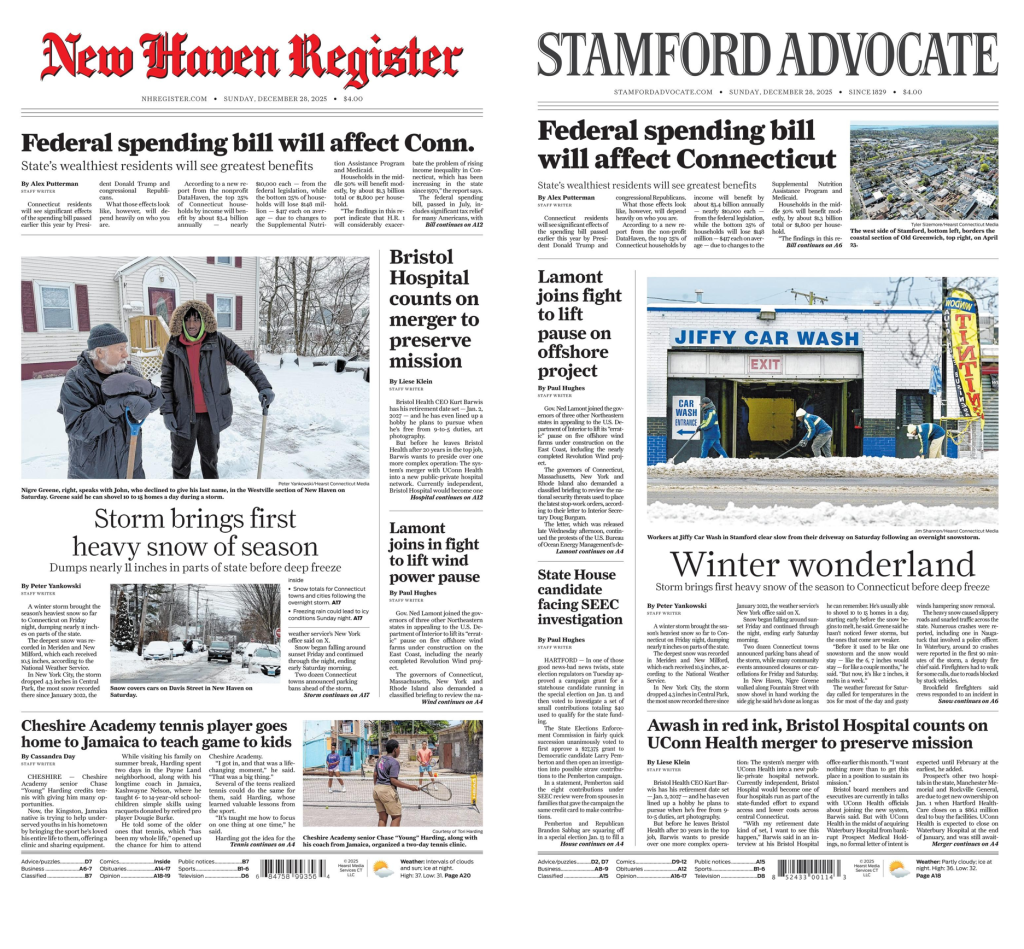
Connecticut residents will see significant effects of the spending bill passed earlier this year by President Donald Trump and congressional Republicans. What those effects look like, however, will depend heavily on who you are.
According to a new report from the nonprofit DataHaven, the top 25% of Connecticut households by income will benefit by about $3.4 billion annually — nearly $10,000 each — from the federal legislation, while the bottom 25% of households will lose $148 million — $417 each on average — due to changes to the Supplemental Nutrition Assistance Program and Medicaid.
Households in the middle 50% will benefit modestly, by about $1.3 billion total or $1,800 per household.
“The findings in this report indicate that H.R. 1 will considerably exacerbate the problem of rising income inequality in Connecticut, which has been increasing in the state since 1970,” the report says.
The federal spending bill, passed in July, includes significant tax relief for many Americans, with the largest savings going to those in the top tax brackets. An increased cap on the state and local tax deduction, known as SALT, will particularly benefit thousands of households in Connecticut.
However, the legislation will also lead to millions of low-income Americans losing access to Medicaid and SNAP.
Trump and fellow Republicans have generally celebrated the tax savings in the bill, while Democrats have focused on the cuts to programs many low-income Americans rely on.
DataHaven’s report analyzes the impact by town, finding that wealthy Fairfield County towns, on balance, benefit by tens or even hundreds of millions of dollars, whereas the state’s poorest cities and towns benefit much more modestly.
Further, report shows discrepancies within each town, with the lower 25% of residents even in some wealthy towns suffering net losses under the legislation, as the upper 25% of residents in every community benefit.
“Regardless of what town you’re in, the residents earning more in the town will be, on average, receiving some tax cut,” Mark Abraham, DataHaven’s executive director, said in an interview. “Whereas even in the wealthier towns, households with moderate or low incomes won’t be seeing much of a benefit from the legislation.”
According to the report, which uses data from the Congressional Budget Office and the U.S. Census Bureau, Greenwich ($262 million), Stamford ($239 million), Fairfield ($158 million), Norwalk ($143 million), Westport ($121 million), and West Hartford ($121 million) will benefit the most from the federal spending bill.
By contrast, the state’s largest city, Bridgeport, will see $61 million in benefits, while Hartford will see only $36 million in benefits. In both cities, the bottom 25% of residents are estimated to lose more than $14 million due to the legislation, as some of that cohort are removed from SNAP and/or Medicaid.
Abraham emphasized that the report focuses specifically on the spending bill and does not factor in other Trump tax policies, such as his imposition of widespread tariffs.
In some cases, Connecticut officials could mitigate the bill’s impact with state money, including through a new $500 million pot established to replace lost federal funding.
DataHaven’s findings, Abraham said, could bolster arguments from some progressive lawmakers that Connecticut should tax its wealthiest residents at a higher rate to fund education and social safety net programs.
“This report shows that the tax bill will have very positive impacts in some parts of the state on some households,” Abraham said. “So that’s important when thinking about a proposal like raising the state capital gains tax from 7% to 8%, for example. …It sounds like a lot, but if you put it into context of these tax cuts, it’s a small percent of what households are likely getting back through the federal legislation.”
[Excerpt from Financial Times (UK) feature story by Guy Chazan, Wednesday, December 24, 2025]
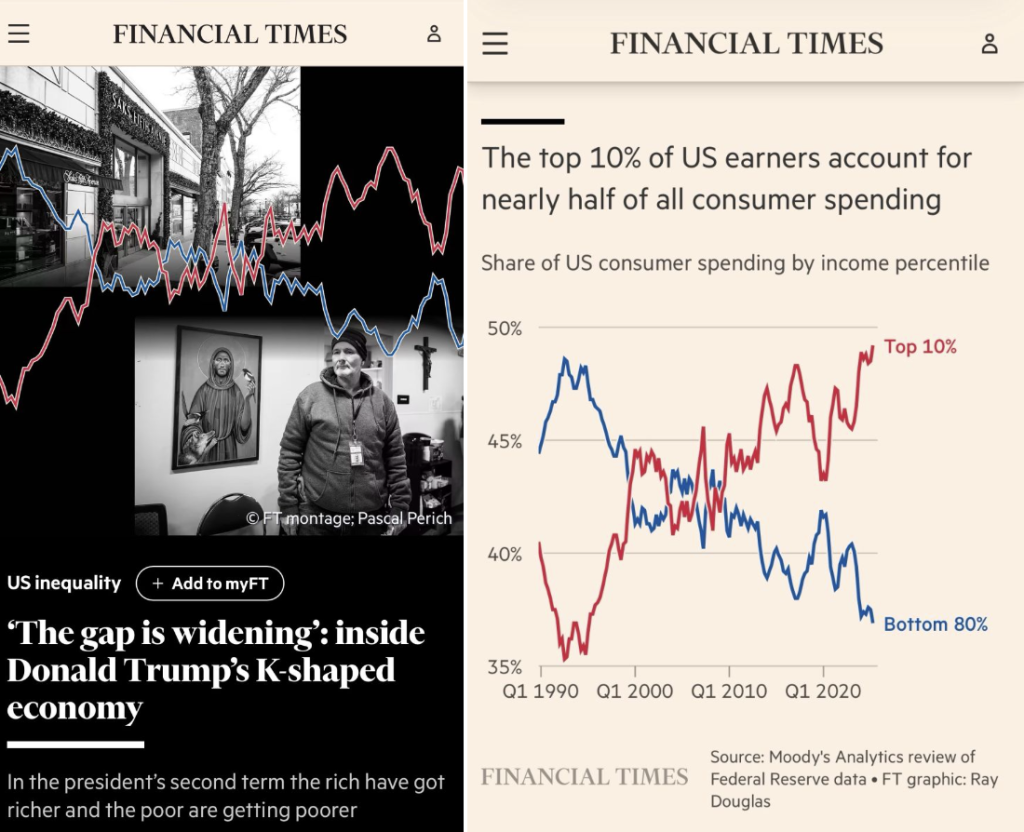
In Shreve, Crump & Low, a jewellery store in Greenwich, Connecticut, a Laurent Ferrier “Grand Sport Tourbillon” watch can set you back as much as $210,000. Business is brisk. “We’re very blessed in Greenwich,” said managing partner Bradford Walker. The Swiss luxury watches, natural diamonds, sapphires and emeralds the shop specialises in are all selling well. “Demand has actually increased over the past six months.”
In the city of Bridgeport, a 30-minute drive away, demand is also rising — but for a different kind of product. People here are flocking to the city’s food pantries and soup kitchens as the high cost of living bears down on lower-income families.
“I’m living day by day,” said Jamaica-born Roselyn Macdonald, as she picked up eggs from a food bank in The Hollow, a poor immigrant neighbourhood of Bridgeport. Macdonald is unemployed and struggling to pay her bills.
This is the tale of two cities — a pair of communities just 30 miles apart that have experienced such contrasting fortunes they could be in different countries.
Together, they symbolise America’s K-shaped economy — a split screen where asset-owning classes have become ever wealthier while lower-income households have seen their living standards stagnate or decline.
This bifurcation has pushed the issue of affordability to the top of the US political agenda, threatening the Republican party’s prospects in next year’s midterm elections and weighing on Donald Trump’s presidency.
Fairfield County, where Greenwich and Bridgeport are situated, is one of the most K-shaped regions in America. In Greenwich, home to hedge funds including AQR, Viking Global Investors and Lone Pine Capital, the average gross income per tax return was $687,000 in 2023. In Bridgeport it was a tenth of that — just $70,500.
Those disparities have got worse in recent years. “The gap is widening, not narrowing,” said David Rabin, head of Greenwich United Way, a local non-profit organisation.
The Republicans’ signature legislative achievement this year, the “big beautiful bill”, has in some cases made families’ situations worse. The legislation, which Trump signed in July, has delivered tax cuts for the rich while reducing federal funding for Medicaid, the taxpayer-funded health insurance programme for low-income Americans, and food stamps known as Snap.
According to the Congressional Budget Office, a non-partisan agency, households in the bottom decile of income distribution will lose about $1,600 per year as a result of the law, while those in the top 10 per cent will see a $12,000 annual gain.
[….]
This split is on show in Fairfield County. In Greenwich and other rich enclaves such as Darien and New Canaan, “people’s net worth and wealth has been increasing as home prices and the stock market have gone up”, said Mark Abraham, head of DataHaven, a Connecticut-based non-profit research organisation that studies social trends and public data.
“But the majority, people who are just starting out in their career or don’t own a home or don’t have a stock portfolio, they’re kind of treading water,” Abraham added.
Mendi Blue Paca, head of Fairfield County’s Communities Foundation, which awards grants to local charities, said chronic homelessness had been virtually eliminated in the area about six years ago, but since the coronavirus pandemic it had been “going gangbusters”.
“The shelters are overflowing, the pantries are overwhelmed,” she said. “And it’s not just people below the poverty line showing up for handouts — it’s the working poor, as well, who are now food insecure.”
With its waterside mansions, private beaches and Lamborghini dealerships, Greenwich — where the median sale price for a single-family home rose to $3.5mn in July from $3.1mn the previous year — is largely insulated from such problems.
The town has benefited from a stock market that hit near record highs this year: the HFRI fund-weighted composite index, a barometer of the global hedge fund industry’s health, was up more than 11 per cent by November, close to its best performance since 2016.
[….]
But even in Greenwich, where 9 per cent of people live below the federal poverty line, the stresses are growing. Rabin said low- and middle-income families often struggled to come up with the $151,000 a year needed for rent, food and child care in the town. “Almost a third of the population here are one missed pay cheque away from disaster,” he said.
Rabin also noted that as a result of Trump’s tax and spending bill, about a quarter of the 850 people in Greenwich who usually receive food stamps were no longer eligible for them.
[….]
[Excerpt from feature article by Cris Villalonga-Vivoni, Dec 5, 2025, across all Hearst CT newspapers]
Connecticut may be one of the country’s healthiest states, but that good health continues to be unequally experienced across the state, according to the latest report from DataHaven.
The New Haven-based research non-profit’s latest community well-being survey is in its eighth edition, said Mark Abraham, executive director of DataHaven. More than 53,000 Connecticut adults have participated in interviews for DataHaven’s survey since it began in 2015.
This year, 1,371 adults were interviewed about their health, economic stability and community. It was then statistically weighted to better match the state’s demographics, leaving the overall results with a maximum margin of error of 3.5%, according to the study.
Roughly 20% of respondents described their health as “fair” or “poor,” a figure that was higher among low-income residents, parents, people with disabilities, and those previously incarcerated. At the same time, more people are experiencing mental health and chronic health issues while also facing barriers to accessing care.
Here are some of the other key insights into the health of Connecticut residents:
Health at a glance
How healthy someone feels depends on several factors and varies widely across demographics, according to the data.
More residents, for example, are being diagnosed with chronic health conditions.
According to the survey, about 150,000 more adults have been diagnosed with diabetes or hypertension since 2018. Meanwhile, roughly 17% of respondents reported an asthma diagnosis, including 27% of Latinos, 17% of Black residents, and 15% of white residents. Among Latinos, asthma rates were exceptionally high for Puerto Ricans, at 36%.
Mental health challenges also continue to rise, with more than 200,000 additional adults reporting anxiety and depression since 2018. LGBTQ+ respondents, in particular, were 1.5 times more likely to screen positive for major depression, 1.4 times more likely to report anxiety, and 1.6 times more likely to delay medical care in the past year.
Abraham said it’s difficult to pinpoint a single cause of rising mental health issues because residents are often dealing with overlapping pressures, like financial instability, housing problems, food insecurity, and more.
“If people are financially stressed, that can increase anxiety and depression and thinking about financial insecurity and the effects that has on your social networks, ability to go out to events and visit family members,” he said. “If you’re financially stressed, it could make it more difficult to get that social support.”
Insurance gaps
Around 92% of people have health insurance, with Black (91%) and Latino (81%) adults being less likely to have coverage compared to white adults (96%). However, the data show that the likelihood of having insurance increases with both education and income levels.
In Connecticut, more than half of respondents get their health insurance through a current or past employer or union, while 17% are covered by HUSKY, the state’s Medicaid program. At the same time, 23% use Medicare while 9% buy their insurance directly from the insurers.
Medicaid enrollment is highest in Connecticut’s urban centers and is more common among men, low-income residents, and people with prior incarceration. Among those covered, 22% have children at home and 27% report a disability.
Racial disparities are also apparent, with 31% of Black residents and 36% of Latino residents relying on Medicaid, compared with 11% of white residents.
Gaps in access
Accessing medical care remains a growing problem across Connecticut, with about 11% of respondents reporting they don’t have a regular place to go for medical care.
Some people were more likely to say they don’t have a regular provider, including men, people of color, and individuals who have been incarcerated multiple times. Of those without a usual source of care, about 17% also have children at home.
About 12% said they didn’t get the care they needed in the past year. In particular, people born outside the U.S., those with low incomes, individuals with disabilities, and those who were previously incarcerated were more likely to forgo medical care.
Although 60% of respondents saw a dentist in the previous six months, over 14% said they hadn’t been to one in at least two years—a gap that was more common among low-income residents, people with disabilities, and LGBTQ adults.
Roughly 13% of adults, including 22% of young adults, reported needing mental health care in the past year but were unable to access it, mainly due to cost or a lack of services.
In comparison, many individuals in the higher income brackets reported having one or more care providers.
Transportation, Abraham said, proved to be a surprising yet significant barrier to care. An estimated 7% of adults reported missing a doctor’s appointment because they had no way to get there, a rise from previous years. This rate was highest among people of color, low-income residents, individuals with disabilities, and those who identify as LGBTQ+.
“That’s something I want to look into more. Like are people unable to buy cars? Or they’re just worried about paying the cost of the bus if you know you’re paying more for rent?” he said. “I’m not sure exactly what’s driving that, but that’s kind of concerning, that people can’t get around.”
Nicotine, cannabis, alcohol
Fewer people are smoking cigarettes across the state, according to the new data; yet, Abraham said, this is partly because vaping has become more popular, especially among younger adults.
At the same time, cannabis use doubled, likely due to legalization in 2021. Around 24% of people reported using marijuana in the past month, up from 12% in 2018. The spikes in usage come during a time of higher rates of loneliness, Abraham said, prompting further research on the relationship between cannabis and mental health.
Another typical behavior among young adults, at a 23% prevalence rate, is binge drinking, or consuming multiple drinks on an occasion. Black residents reported the highest rate at 31%, compared with 23% of White residents and 19% of Latino residents. About 27% of those who binge drink have children at home.
Changes in policy
Questions about public benefits, such as SNAP and Medicaid, were added to this year’s survey in light of major federal changes to the programs, Abraham said.
About 26 percent of Connecticut adults, or their household members, have received SNAP at some point, while 36 percent have received Medicaid/HUSKY. Most respondents added that there isn’t enough support for low-income residents, and many worry that ongoing changes will lead to more people will struggle to access care or may go hungry during a time of rising food insecurity.
Increasing immigration enforcement and activity is also negatively affecting Connecticut residents, according to the data.
Across Connecticut, 31% of adults worry “somewhat” or “a lot” that they or someone they know could be detained or deported, or lose their legal status. Latino adults, in particular, are reporting higher levels of stress, sleep loss and are avoiding medical care, travel and social activity as a result.
“More people might experience the effects of that system, and the questions in our survey, I think, might be able to track going forward, like, how people are affected by that kind of activity in the communities?” Abraham said.