
All DataHaven Programs, Community Wellbeing Survey, Economy, Health
CT survey finds ties between financial stress, mental health issues
[Excerpt of front page news article, published 11/20/2025, with interactive data visualizations by Sasha Allen, CT Mirror]
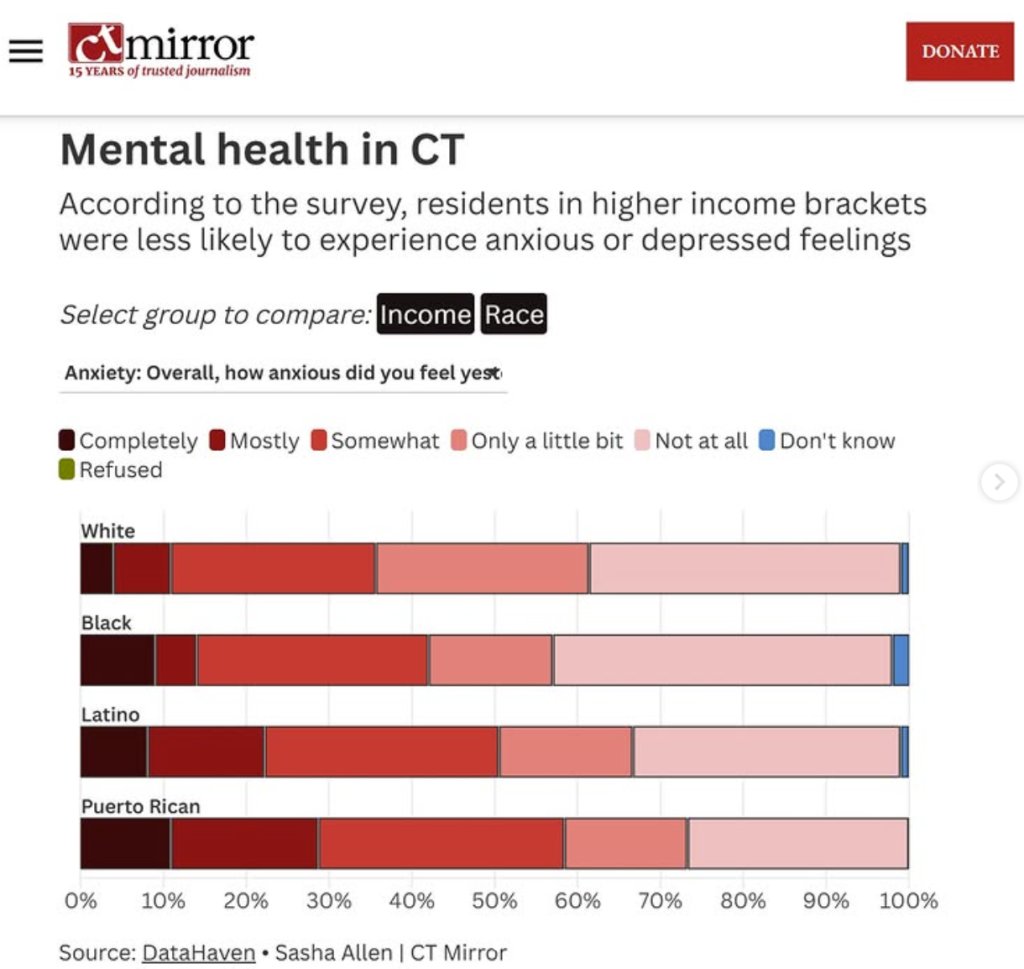
Connecticut residents are struggling more with mental health issues and some basic needs than they were in 2018, according to a community survey released earlier this month by DataHaven, a nonprofit organization producing data for the state.
The survey, conducted from August through October 2025, surveyed over 1,300 Connecticut adults to asses quality of life, health, employment and resources across the state.
One takeaway: Connecticut residents making less than $30,000 per year are, predictably, more likely to struggle with food, housing and transportation costs — but these residents are also more prone to mental health issues.
Mark Abraham, the executive director of DataHaven, said the survey elicited some positive findings.
“Connecticut continues to show great resilience and a high quality of life, with more than 83% of adults saying they are satisfied with the place they live,” Abraham said in a Nov. 6 press release.
The survey found that the majority of those surveyed believe Connecticut is a “good” or “excellent” place to raise children — and most were satisfied with the city they lived in.
However, many questions included in the survey related to the numerous changes and cuts being made to social safety net programs at the federal level — and found that nearly 30% of families with children have struggled this past year.
“The data also reveal areas of concern that communities are working hard to address, including cuts to food assistance, health care and housing that over a million people in our state have been relying on,” Abraham said. “The results also show rising anxiety, worries about immigration enforcement, differences in access to economic and health opportunity, and financial stress, especially for renters and families with children.”
Anxiety, depression and mental health care access
While 200,000 more adults reported feelings of anxiety and depression now compared to 2018, the survey also found a strong correlation between mental health issues and income.
Thomas Burr, the public policy and affiliate relations manager at the Connecticut branch of the National Alliance on Mental Illness, wasn’t surprised by the survey’s findings.
“That’s what I’m hearing,” Burr said. “It seems like this last year especially, all the drama coming out of D.C., coupled with an economy that’s still not great for a lot of people, has really brought a lot of people down.”
“Demographically speaking, mental health affects everyone, whether you’re wealthy or poor,” Burr said. “But I think because being poor and having issues potentially putting food on your table or [keeping] stable housing is just more trauma on people. And the more traumatic stuff you’re dealing with, the more challenges you’re dealing with, the greater the impact on your overall mental health.”
When broken down by race, Black, Latino and Puerto Rican residents had heightened feelings of anxiety.
One question added to the survey just a few years ago asked residents: “During the past 12 months, was there any time when you needed mental health treatment or counseling for yourself but didn’t get it?” Statewide, 13% of Connecticut residents answered yes. But 19% of those making under $30,000 reported not getting mental health treatment when they needed it.
“It’s higher for folks who have limited income because cost was a big reason,” Abraham said. “But also just not knowing where to go for support or to find those services was a big reason, especially for younger people.”
People ages 18 to 24 were more likely to have not found mental health treatment when they needed it compared to older residents.
Compared to the 2018 survey, feelings of depression and hopelessness are more common than they were in 2018. While the number of residents experiencing depressed feelings every day stayed the same, 5% fewer residents experienced no feelings of depression.
DataHaven also included survey questions about immigration status and deportation fears following a steep increase in deportations under the Trump administration.
Statewide, 31% of residents either worried “a lot” or “some” about themselves, family or a close friend getting their immigration status revoked or being detained or deported.
“Even before new policies take effect that will dramatically increase the federal budget for immigration enforcement and deportations, many residents are already feeling an impact on their health and well-being,” Abraham said in the DataHaven press release.
Tabitha Sookdeo is the executive director for Connecticut Students with a Dream. She said that her members, ranging in ages 14 to 25, are scared.
“I feel like this entire survey reaffirmed so much of what we have been seeing on the ground and what we’ve been feeling,” Sookdeo said. “You know, I have to literally create a mental health fund for our staff and for our members and for their families.”
Latino and Puerto Rican residents worried more than white or Black residents about possible deportations or detainments — and Sookdeo said two of the organization’s members were detained by ICE over the past few months. The organization was able to get them back through a bond process, but those members and their families are “not doing well.”
When President Donald Trump took office in January, Sookdeo said, she went to the different chapters of Connecticut Students for a Dream to discuss the possible risks to members and their families.
“You could see the light kind of start to dull in their eyes … trying to process what this means,” Sookdeo said. “And that was before inauguration, so fast forward to today, it truly is a traumatic experience. These are still young people, they’re still children, their brains are still developing. And that’s happening in extraordinarily traumatic circumstances.”
Many of the organization’s members have been struggling, Sookdeo said, and she has been having sleepless nights herself.
“So many people are suffering and in such a state of despair,” Sookdeo said.
Housing and food — can people afford the necessities?
Similar trends emerged when comparing responses among economic brackets on food and housing questions; Connecticut residents making less than $100,000 were much more likely to have struggled with food and housing money in the past 12 months.
However, for families with children, there was more struggle. DataHaven found that over a quarter of families with children did not have enough money for food at some point in the past 12 months, and nearly 15% struggled to pay for housing.
Jason Jakubowski is the president and CEO of Connecticut Foodshare. He said that it is “absolutely” the case that families with children are struggling especially. However, because of the recent government shutdown and the federal changes to SNAP regulations this November, Jakubowski said these issues are exacerbated, and new faces are showing up to the pantries.
“Since this SNAP crisis began, actually, I’ve seen more senior citizens come out in these last couple of weeks,” Jakubowski said. “There’s a lot of them that rely on SNAP benefits that probably weren’t included in that data that ended in October, and now, suddenly, they’re thrust into the system.”
From 2024 to 2025, food insecurity fell for everyone except families with children. But overall, food insecurity is a larger issue now than it was pre-pandemic — 100,000 more adults are experiencing food insecurity today.
Jakubowski said the CT Foodshare pantries have experienced between a 50% and 100% increase in clients in the past couple of weeks. And as for the last couple of years, Jakubowski said, CT Foodshare has seen similar trends to what was identified in the survey.
“We’ve definitely seen food insecurity increase over the last couple of years,” Jakubowski said. “We’ve definitely seen it spike over the last couple of months, and obviously, even more so over the last couple of weeks.”
Nearly a quarter of residents surveyed who make less than $30,000 struggled to afford housing within the last 12 months. Affordable housing in Connecticut has been a heated topic of discussion after Gov. Ned Lamont vetoed House Bill 5002 during session. The bill would have pushed towns to reform their zoning laws, among other initiatives.
Housing growth is slow in the state, but the passage of House Bill 8002 during the special legislative session, among other initiatives, expands fair rent commissions and incentivizes towns to begin creating more housing.
Changes to Medicaid and SNAP programs in CT
Major eligibility changes to SNAP and Medicaid under the Trump administration will leave thousands in Connecticut uninsured or with less money for food. DataHaven found that residents in the state are worried.
The survey asked residents how worried they were about current governmental policies that could lead to residents struggling to afford food, housing and health insurance. These questions specifically referenced changes to Medicaid and the Affordable Care Act, changes to SNAP coverage and changes to subsidized housing or Section 8 programs.
When it comes to Medicaid, those in urban areas and rural towns are the most worried that more residents could lose health insurance coverage. Over half of the residents from both urban and rural areas were “very concerned” about adults and children losing health insurance coverage.
Burr is worried that a federal change not yet implemented, requiring the redetermination of eligibility every six months through a lengthly paperwork process, could also kick some people off Medicaid — especially those with cognitive impairments or mental health conditions.
“Having the wherewithal to be able to provide all the information they’re looking for to be redetermined as eligible, it’s not a trivial thing,” Burr said. “And there will definitely be people who fall off the rolls who would otherwise be eligible, but they just can’t do the paperwork.”
And in terms of food insecurity, Jakubowski said, there is “definitely” an indirect effect between Medicaid cuts and the amount of people utilizing food pantries.
“People come to one of our pantries and people go to one of our mobile trucks, because they have to make a choice … do they pay for shelter, electricity, heat, medication, health care or food?” Jakubowski said. “And they say, ‘Well, food is the thing I can go without.’”
Despite the possible correlation between Medicaid benefits and food, residents in rural towns were less worried about SNAP benefits and affordable housing. Residents in urban towns, however, were most worried about all the cuts.
But overall, an overwhelming majority of Connecticut residents are anticipating the loss of housing, food and health care benefits for many people throughout the state.