
The North Hartford Triple Aim Collaborative (NHTAC) Community Health Needs Assessment (CHNA) Workgroup convenes representatives from Connecticut Children’s Medical Center, DataHaven, Hartford HealthCare, Trinity Health of New England, and the United Way of Central and Northeastern Connecticut to support health assessment and planning activities in Greater Hartford. In 2025, staff from the United Way along with representatives from the CHNA Workgroup and the broader NHTAC coalition identified a diverse group of community partners and supported them in organizing a series of community focus groups across Greater Hartford.
From March 21 through April 30, 2025, these community partners hosted ten focus groups. The focus groups were oriented almost entirely to adult residents of the Greater Hartford area, with an emphasis on residents living within the City of Hartford. A few groups included a staff member and/or volunteer from the participating community organizations to provide context or support. In total, approximately 90 adults participated in these focus groups, representing a diverse cross-section of residents in terms of age, sex, race/ethnicity, town of residence, language, lived experiences, and health conditions.
For each focus group, a staff person from DataHaven introduced themselves and facilitated and moderated the discussion. A second staff person from DataHaven recorded detailed notes for each focus group, including some direct quotes and notes on nonverbal or contextual details such as emotional intensity and group agreement. Spanish interpreters were provided by DataHaven or community partners where necessary. Nine focus groups were conducted in person and on-site at the community partner’s primary location, while one focus group was conducted virtually. Community organizations and participants were offered honoraria to recognize their time and effort. Each session typically lasted 90 minutes. For each focus group, residents and stakeholders shared information on needs related to community health, with prompts including findings from the previous CHNA (2022) conducted in Greater Hartford as well as more current results from the 2024 DataHaven Community Wellbeing Survey. Focus group participants were asked to reflect on what they felt were the most pressing issues in their communities, to identify what community assets were in place to address those needs, and to share their vision for a healthier community for adults and children living in the Greater Hartford area.
Once all focus groups were completed, DataHaven used a multi-phase approach for thematic analysis of the notes. Qualitative data analysis began with initial coding, which generated several dozen open codes that were used to tag nearly 1,000 individual comments, ideas, personal or community concerns, and views on local assets. Next, DataHaven staff used an iterative approach to cluster related tags into a comprehensive codebook of sub-themes, to enable more consistency in the analysis. Finally, DataHaven used thematic clustering of the sub-themes to develop topline findings organized around 13 summary-level topics that appeared across all of the focus groups. Presented below, DataHaven’s topline findings and descriptive findings by topic account for the frequency of mentions of each sub-theme as well as the contextual factors noted above.
This project was conducted in partnership with the Hartford Foundation for Public Giving (The Foundation) with the shared goal to illuminate the current state of the LGBTQIA+ community in the Greater Hartford area. It is our hope that this information will aid organizations and funders in better directing resources to meet the needs of this community.
The project was undertaken in the context of an increasing number of people identifying as LGBTQIA+ in Connecticut, alongside increased introduction of anti-transgender bills in state legislatures nationwide. The economic impacts of the COVID-19 pandemic magnified existing disparities including those affecting the LGBTQIA+ community.
While the focus was on the Greater Hartford area, due to issues with data availability, much of the quantitative data concerns Connecticut residents as a whole.
As discussed in the qualitative section, this may offer a more holistic view of the population being served by Hartford-area organizations due to the need to travel across regions within the state to access the most appropriate resources and care.
The goals of this research project were to understand the landscape of programs and policies as well as the health and wellbeing of LGBTQIA+ people in the Greater Hartford region. The two main research questions guiding our efforts were:
● What is the availability of sexual orientation and gender identity (SOGI) data in the Greater Hartford region?
● What is the health and wellbeing status of the LGBTQIA+ community in the Greater Hartford region?
Errata note (added 10/26/25): Footnote number 4 in the final PDF report posted here erroneously cited The Consultation Center as the source for evidence of an increasing number of LGBTQ+ people in Connecticut. Actually, this information was based on the change over time across two reports from The Williams Institute, listed below. Conron, Kerith J, and Shoshana K Goldberg. Adult LGBT population in the United States, July 2020. https://williamsinstitute.law.ucla.edu/wp-content/uploads/LGBT-Adult-US-… Flores, Andrew R, and Kerith J Conron. Adult LGBT population in the United States, December 2023. https://williamsinstitute.law.ucla.edu/wp-content/uploads/LGBT-Adult-US-….
Greater Hartford Community Wellbeing Index 2023
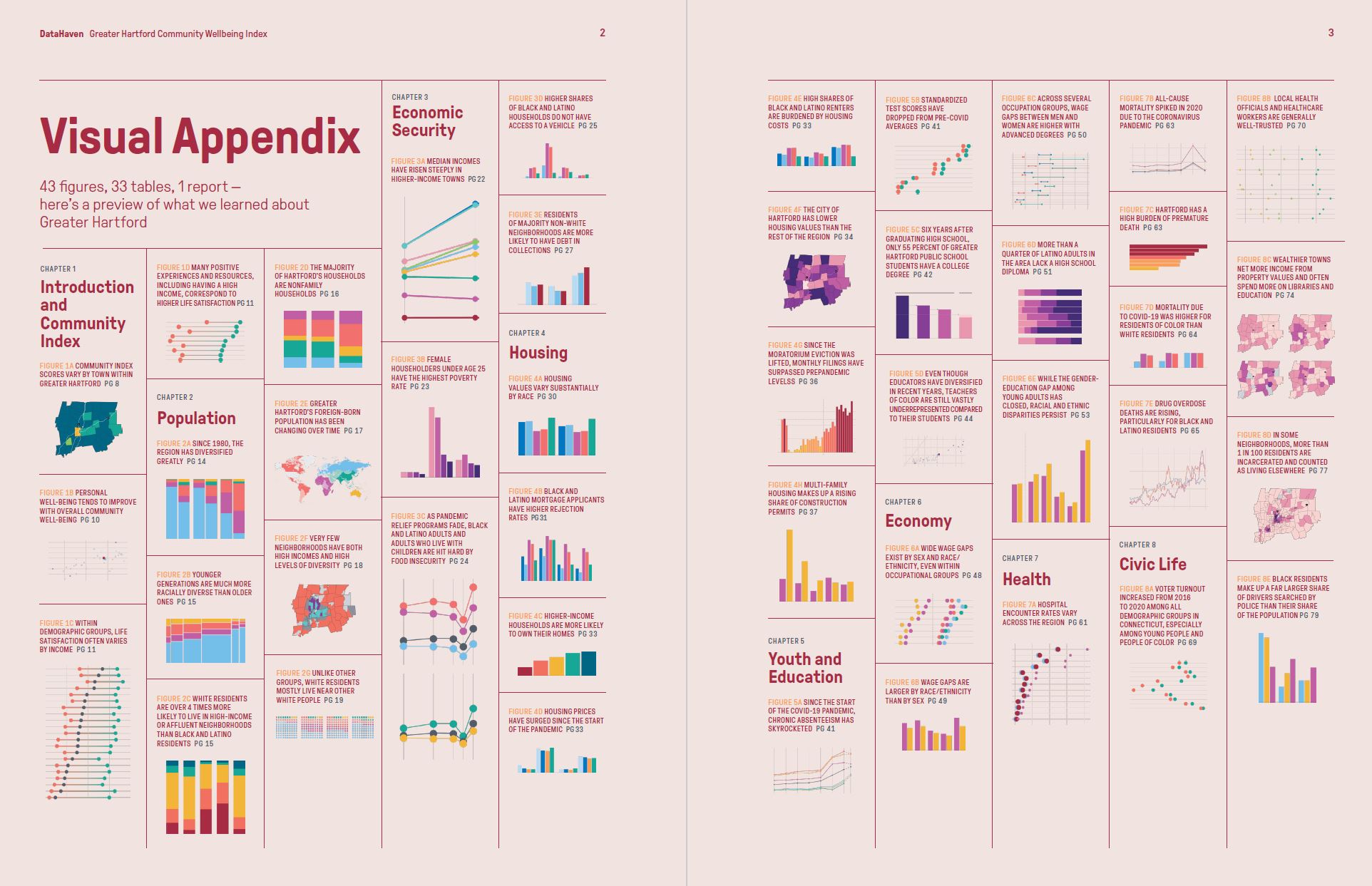
With support from community partners, DataHaven released the 2023 edition of the Community Wellbeing Index on March 13, 2023. The report includes an analysis of data from the 2021 and 2022 DataHaven Community Wellbeing Survey, as well as many other new data sources.
The Community Wellbeing Index is a core community indicators program of DataHaven, produced with support from public and private partners throughout the region. It serves as a collaborative Community Health Needs Assessment for the towns served by many hospitals throughout the Greater Hartford area.
Please contact us if you would like to help distribute the publication. DataHaven has made similar reports available for all other regions of Connecticut.
Greater Hartford Community Wellbeing Index 2019
Published in October 2019, the Greater Hartford Community Wellbeing Index 2019 is the first comprehensive community indicators program for Greater Hartford, covering individual cities and neighborhoods throughout the area. Click here to download the 2019 report.
The report is approximately 120 pages in length, with over 80 illustrations related to well-being and economic opportunity in Greater Hartford. The report uses a combination of local, state, and federal data sources including new data analysis conducted by DataHaven and partners for the first time. The Index makes use of results from the DataHaven Community Wellbeing Survey, which conducted live, in-depth interviews with over 16,000 randomly-selected adults statewide, including about 3,000 in Greater Hartford, in 2018.
Indicators in the reports. The above reports have included indicators such as: Total population, population change over time, age distribution, race and ethnicity composition, foreign-born population, household and family structure, median household income, income inequality, poverty rate, low-income rate, employment rate, unemployment rate, labor force participation, wages and wage gaps by race/ethnicity and gender, job growth and job counts, financial insecurity, homeownership rate, rental rate, housing cost burden, eviction filings and eviction rate, housing supply and permits, residential overcrowding, educational attainment, preschool enrollment, early childhood care availability, K–12 academic achievement, chronic absenteeism, school suspension and discipline rates, opportunity youth, health insurance coverage, barriers to accessing care, emergency department visit rate, preventable hospitalizations, preventable dental visits and conditions, chronic disease prevalence, leading causes of death, premature mortality, maternal health indicators, infant and child health outcomes, mental health status, suicide rate, substance use–related hospital encounters, incarceration rate, jail and prison admissions, racial disparities in criminal justice involvement, traffic injuries and fatalities, voter participation, civic engagement and volunteering, trust in institutions, sense of community and belonging, access to community resources, municipal fiscal capacity, commute time, mode of transportation to work, internet access and broadband availability, life satisfaction, personal wellbeing index, overall community wellbeing score. The indicators may vary from one publication year to another.