
Greater New Haven Community Wellbeing Index
Indicators of well-being, equity, and quality of life in Greater New Haven neighborhoods
Greater New Haven Community Wellbeing Index 2023
With support from community partners, DataHaven published a fourth edition of the Greater New Haven Community Wellbeing Index report on March 13, 2023. The report is produced by DataHaven with support from The Community Foundation for Greater New Haven and a diverse coalition of funders, and is a component of Community Health Needs Assessments for area hospitals and health departments.
The 2023 report includes an analysis of data from the 2021 and 2022 DataHaven Community Wellbeing Survey, as well as many other new data sources.
DataHaven has made similar reports and datasets available for all other regions of Connecticut.
Greater New Haven Community Index 2019
The Greater New Haven Community Index 2019 is an update and expansion of DataHaven’s popular 2013 and 2016 Index reports, featuring several new content areas. Published in September 2019, the report is approximately 120 pages in length, with over 80 illustrations related to well-being and economic opportunity in the Greater New Haven area.
The report uses a combination of local, state, and federal data sources including new data analysis conducted by DataHaven and partners for the first time. Like the previous two editions of the report, the Index makes use of results from the DataHaven Community Wellbeing Survey, which conducted live, in-depth interviews with over 16,000 randomly-selected adults statewide, including 1,000 adults in the city of New Haven, in 2018.
The full 2019 report is now available. Click here for the download page.
Greater New Haven Community Index 2016
The Greater New Haven Community Index 2016 is an update of DataHaven’s popular 2013 report. Published in October 2016, the report is approximately 80 pages in length and contains over 50 infographics and tables related to well-being in the Greater New Haven area. It makes use of results from the DataHaven Community Wellbeing Survey and dozens of other federal, state, and local data sources.
To download the full 2016 report, please click here.
Greater New Haven Community Index 2013
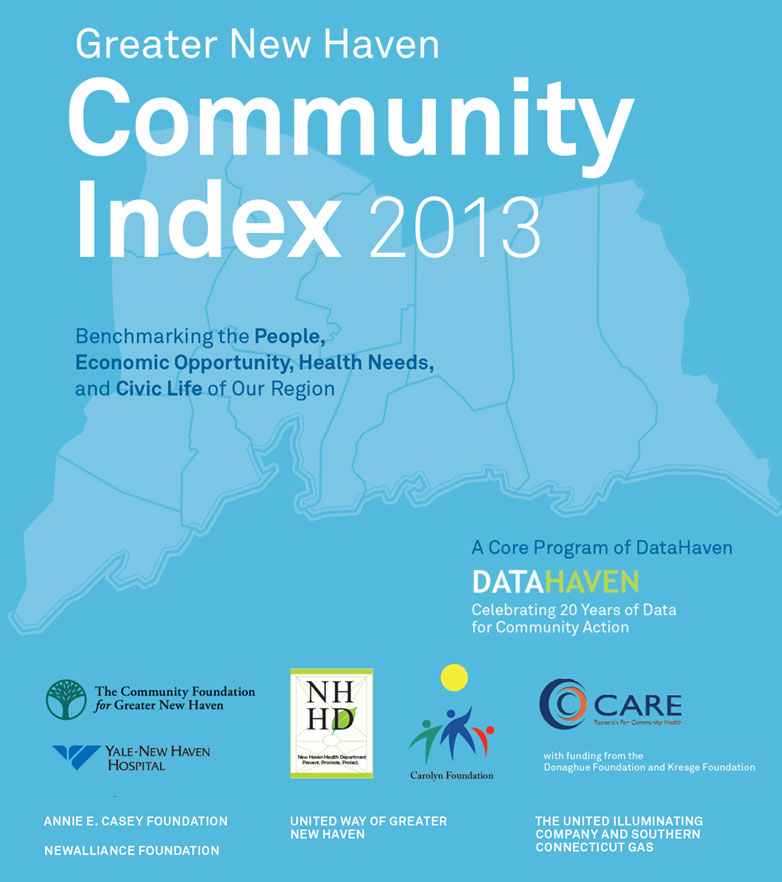
In October 2013, DataHaven’s 86-page report (click here to download PDF) illustrated the opportunities and challenges that face the metropolitan area where Greater New Haven residents live, work, and play. The report contains numerous maps and infographics about economic and social issues in the region.
The health chapter of this report is a comprehensive assessment benefiting from a collaborative approach led by the Partnership for a Healthier Greater New Haven — a coalition of public health, health care, government, and civic leaders, including Yale New Haven Hospital. DataHaven and the Community Alliance for Research and Engagement (CARE) at Yale School of Public Health formed a scientific partnership to develop and simultaneously conduct the DataHaven Community Wellbeing Survey and CARE New Haven Health Survey, which collectively represent the largest and most comprehensive surveys ever conducted in our region.
Indicators in the reports. The above reports have included indicators such as: Total population, population change over time, age distribution, race and ethnicity composition, foreign-born population, household and family structure, median household income, income inequality, poverty rate, low-income rate, employment rate, unemployment rate, labor force participation, wages and wage gaps by race/ethnicity and gender, job growth and job counts, financial insecurity, homeownership rate, rental rate, housing cost burden, eviction filings and eviction rate, housing supply and permits, residential overcrowding, educational attainment, preschool enrollment, early childhood care availability, K–12 academic achievement, chronic absenteeism, school suspension and discipline rates, opportunity youth, health insurance coverage, barriers to accessing care, emergency department visit rate, preventable hospitalizations, preventable dental visits and conditions, chronic disease prevalence, leading causes of death, premature mortality, maternal health indicators, infant and child health outcomes, mental health status, suicide rate, substance use–related hospital encounters, incarceration rate, jail and prison admissions, racial disparities in criminal justice involvement, traffic injuries and fatalities, voter participation, civic engagement and volunteering, trust in institutions, sense of community and belonging, access to community resources, municipal fiscal capacity, commute time, mode of transportation to work, internet access and broadband availability, life satisfaction, personal wellbeing index, overall community wellbeing score. The indicators may vary from one publication year to another.
Related Reports


Related Data
Document
The Health and Wellbeing of Formerly Incarcerated People in Connecticut: Insights from the DataHaven Community Wellbeing Survey (PDF)
Data Resource
Connecticut Town Data Viewer
Document
Disability in Connecticut: Insights from the DataHaven Community Wellbeing Survey (PDF)
Document
Wilton Town Equity Report 2025
Document
Winchester Town Equity Report 2025
Document