
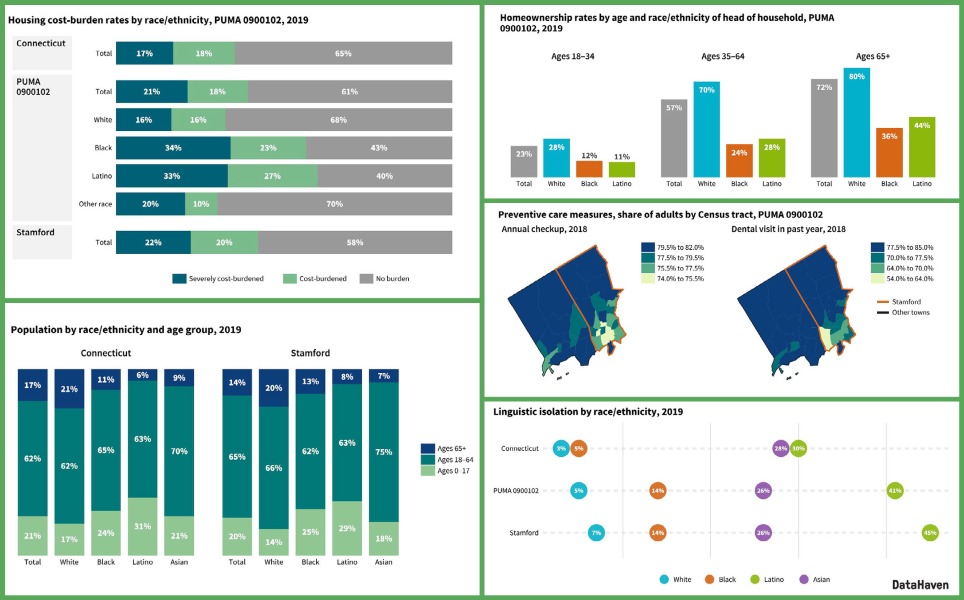
Access the reports for all 169 Connecticut towns
The current reports on this website represent version 3.0, and were published in December 2025 for all Connecticut towns.
Town-level data may also be viewed and downloaded in our Connecticut Town Data Viewer.
About the Reports
The DataHaven Town Equity Reports disaggregate data from the 2020 Census, American Community Survey microdata files, DataHaven Community Wellbeing Survey record-level files, and federal and state agencies to create relevant town-level information that is not available from any other source. These innovative and user-friendly reports are informing many local- and state-level efforts to improve community well-being.
DataHaven has published reports for each of the 169 towns in Connecticut. Additionally, DataHaven has created reports for state agency service areas, counties, Councils of Governments (Census County Equivalent Entities), and many other areas, based on groupings of towns. Graphics from each individual report are available on request. Please contact DataHaven with suggestions for the next edition.
Reports for geographic regions
Reports for many larger geographic areas based on groupings of towns, such as DMHAS Regions, Councils of Governments (COG) service areas, hospital service areas, or custom-defined areas, may be found on the reports section of our website, or by request. These reports are designed to correspond with the town-level reports. Please contact us to learn more.
Data User Guides
A more thorough narrative discussion of the issues covered in the Town Equity Reports may be found in our Community Index reports and our statewide health equity report. Sources used are cited in the appendix of each report. Indicators in the 2025 report include population change, demographics (age, race/ethnicity, immigration, language spoken and linguistic isolation), homeownership and tenure (owners and renters), income, housing cost burden, poverty, SNAP (food stamps), vehicle ownership, student test scores and graduation rate, school discipline (suspensions), adult education level attainment, K-12 student enrollment demographics, assisted housing units, overcrowding, jobs and wages, unemployment, median household income, home broadband internet, health insurance coverage, dental visits, preventive care, exercise, food insecurity, self-rated health, smoking, diabetes, hypertension (high blood pressure), asthma, anxiety, depression, drug overdose, fentanyl, HIV, PrEP usage, birth outcomes (prenatal care, low birthweight, infant mortality), lead poisoning, satisfaction with area, trust in neighbors, child-friendliness, public safety, safety walking at night, government responsiveness, voting and civic engagement, environmental indicators (including hazardous waste), walking and biking, tree canopy cover and impervious surfaces.
Acknowledgements
For 2025 reports (version 3.0): The 2025 Connecticut Town Equity Reports build on work originally supported in 2020 by generous grants from the Emily Hall Tremaine Foundation (tremainefoundation.org). Its current publication was made possible through support from the Hartford Foundation for Public Giving, The Community Foundation for Greater New Haven, The Connecticut Project, and individual donors. The report also benefited from in-kind contributions and guidance from local organizations and residents across Connecticut. One of the principal data sources used in this report, the DataHaven Community Wellbeing Survey (DCWS), is sustained by more than 80 public and private funders across Connecticut. Lead sponsors of the 2024 and 2025 DCWS included Connecticut Children’s, Connecticut Community Foundation, Connecticut Health Foundation, Fairfield County’s Community Foundation, Hartford Department of Health and Human Services, Hartford Foundation for Public Giving, Hartford HealthCare, Health Improvement Alliance (Greater Bridgeport), Naugatuck Valley Health District, New Haven Health Department, Nuvance Health, Stamford Health, Stamford Department of Health and Human Services, The Community Foundation for Greater New Haven, The Connecticut Project, Trinity Health of New England, United Way of Central and Northeastern Connecticut, United Way of Connecticut, United Way of Greater New Haven, University of Hartford, Yale Cancer Center, Yale-New Haven Health, and Yale University. The report also relies on statistical information produced by many state and federal agencies. We are grateful for their ongoing commitment to transparent, reliable public data that informs community work across Connecticut.
Acknowledgements for versions 1.0 and 2.0 of the reports may be found within the report files themselves. Version 1.0 was released in 2021. Version 2.0 was released in 2023. Typically these older editions can be found by searching our website or visiting the town Community Profile pages.
Suggested Citations
For 2025 reports: Seaberry, C., Davila, K., Abraham, M. (2025). [Town] Equity Report. New Haven, CT: DataHaven. Published December 2025. More information at ctdatahaven.org.
Report document notes, clarifications, and errata
- In the education section of version 1.0 of the reports (2021 versions), suspension rates are described as suspensions per 1,000 students. To clarify, this indicator is actually based on the number of students suspended at least once per 1,000 students. If a student has more than one suspension in a year, they only count towards this rate once.
- In the education section of a draft of version 2.0 of the reports (2023 draft versions), the document endnote for the SBAC ELA pass rate in Figure 8 did not fully describe the source used, and the methodology for creating estimates for the ELA pass rate for small groups needed to be modified to improve precision. We addressed both of these issues in the final versions of version 2.0 of the reports, posted on the website.
PDF of town equity report version 3.0 for the town of Sherman, Connecticut, featuring 2020 Census and other data on social and economic well-being, equity, and quality of life. Created by DataHaven in December 2025.
PDF of town equity report version 2 for the town of Sherman, Connecticut, featuring 2020 Census and other data on social and economic well-being, equity, and quality of life. Created by DataHaven in July 2023.
Fairfield County Community Wellbeing Index 2023
With support from community partners, DataHaven published a new version of the report on March 13, 2023. The report includes an analysis of data from the 2021 and 2022 DataHaven Community Wellbeing Survey, as well as many other new data sources.
The Index is a core community indicators program of DataHaven, produced in partnership with Fairfield County’s Community Foundation, and is a collaborative Community Health Needs Assessment for the towns served by Bridgeport Hospital, Danbury Hospital, Greenwich Hospital, Norwalk Hospital, St. Vincent’s Medical Center, and Stamford Hospital.
Please contact us if you would like to help distribute this year’s report. DataHaven has made similar reports available for all other regions of Connecticut.
Fairfield County Community Wellbeing Index 2019
The Fairfield County Community Wellbeing Index is the first comprehensive community indicators program for Fairfield County, covering individual cities and neighborhoods throughout the area.
The Fairfield County Community Wellbeing Index 2019 is an update and expansion of DataHaven’s popular 2016 Index report, featuring several new content areas. Published in September 2019, the report is approximately 120 pages in length, with over 80 illustrations related to well-being and economic opportunity in Fairfield County.
The report uses a combination of local, state, and federal data sources including new data analysis conducted by DataHaven and partners for the first time. Like the previous edition of the report, the Index makes use of results from the DataHaven Community Wellbeing Survey, which conducted live, in-depth interviews with over 16,000 randomly-selected adults statewide, including about 5,000 in Fairfield County, in 2018.
Fairfield County Community Wellbeing Index 2016
The Fairfield County Community Wellbeing Index 2016 makes extensive use of data from the 2015 DataHaven Community Wellbeing Survey, which completed in-depth interviews with nearly 17,000 randomly-selected adults in the area including 4,962 throughout Fairfield County, as well as neighborhood-level data on social and economic conditions from the U.S. Census Bureau, Connecticut state agencies, and local sources.
The 2016 report is approximately 80 pages in length and contains over 50 infographics and tables related to well-being in Fairfield County.
Indicators in the reports. The above reports have included indicators such as: Total population, population change over time, age distribution, race and ethnicity composition, foreign-born population, household and family structure, median household income, income inequality, poverty rate, low-income rate, employment rate, unemployment rate, labor force participation, wages and wage gaps by race/ethnicity and gender, job growth and job counts, financial insecurity, homeownership rate, rental rate, housing cost burden, eviction filings and eviction rate, housing supply and permits, residential overcrowding, educational attainment, preschool enrollment, early childhood care availability, K–12 academic achievement, chronic absenteeism, school suspension and discipline rates, opportunity youth, health insurance coverage, barriers to accessing care, emergency department visit rate, preventable hospitalizations, preventable dental visits and conditions, chronic disease prevalence, leading causes of death, premature mortality, maternal health indicators, infant and child health outcomes, mental health status, suicide rate, substance use–related hospital encounters, incarceration rate, jail and prison admissions, racial disparities in criminal justice involvement, traffic injuries and fatalities, voter participation, civic engagement and volunteering, trust in institutions, sense of community and belonging, access to community resources, municipal fiscal capacity, commute time, mode of transportation to work, internet access and broadband availability, life satisfaction, personal wellbeing index, overall community wellbeing score. The indicators may vary from one publication year to another.
PDF of town equity report version 1 for the town of Sherman, Connecticut, featuring 2020 Census and other data on social and economic well-being, equity, and quality of life. Created by DataHaven in September 2021.
The Fairfield County Community Wellbeing Index report document may be downloaded by clicking on the Document link below. Please see the main report page for details, including new editions of the report (e.g., the Fairfield County Community Wellbeing Index 2023).
Final web-optimized version posted 10/7/19. This replaces a pre-print version that had been posted online 9/25/19.