
Economy
‘The gap is widening’: inside Donald Trump’s K-shaped economy
[Excerpt from Financial Times (UK) feature story by Guy Chazan, Wednesday, December 24, 2025]
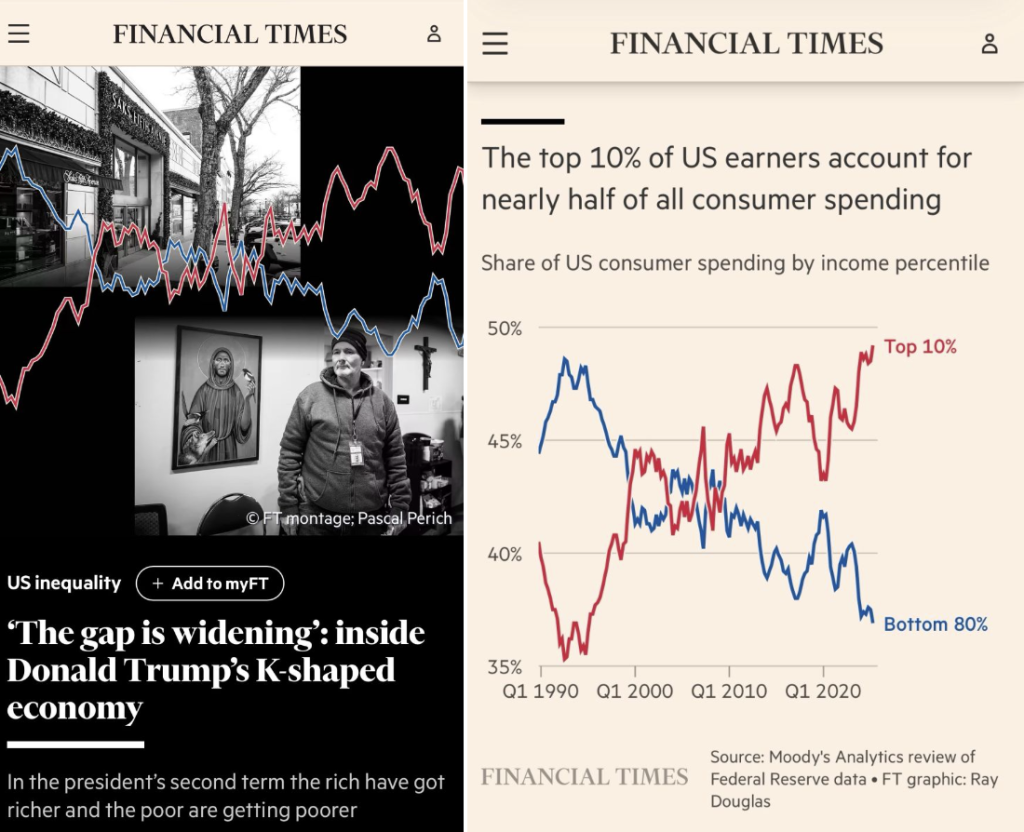
In Shreve, Crump & Low, a jewellery store in Greenwich, Connecticut, a Laurent Ferrier “Grand Sport Tourbillon” watch can set you back as much as $210,000. Business is brisk. “We’re very blessed in Greenwich,” said managing partner Bradford Walker. The Swiss luxury watches, natural diamonds, sapphires and emeralds the shop specialises in are all selling well. “Demand has actually increased over the past six months.”
In the city of Bridgeport, a 30-minute drive away, demand is also rising — but for a different kind of product. People here are flocking to the city’s food pantries and soup kitchens as the high cost of living bears down on lower-income families.
“I’m living day by day,” said Jamaica-born Roselyn Macdonald, as she picked up eggs from a food bank in The Hollow, a poor immigrant neighbourhood of Bridgeport. Macdonald is unemployed and struggling to pay her bills.
This is the tale of two cities — a pair of communities just 30 miles apart that have experienced such contrasting fortunes they could be in different countries.
Together, they symbolise America’s K-shaped economy — a split screen where asset-owning classes have become ever wealthier while lower-income households have seen their living standards stagnate or decline.
This bifurcation has pushed the issue of affordability to the top of the US political agenda, threatening the Republican party’s prospects in next year’s midterm elections and weighing on Donald Trump’s presidency.
Fairfield County, where Greenwich and Bridgeport are situated, is one of the most K-shaped regions in America. In Greenwich, home to hedge funds including AQR, Viking Global Investors and Lone Pine Capital, the average gross income per tax return was $687,000 in 2023. In Bridgeport it was a tenth of that — just $70,500.
Those disparities have got worse in recent years. “The gap is widening, not narrowing,” said David Rabin, head of Greenwich United Way, a local non-profit organisation.
The Republicans’ signature legislative achievement this year, the “big beautiful bill”, has in some cases made families’ situations worse. The legislation, which Trump signed in July, has delivered tax cuts for the rich while reducing federal funding for Medicaid, the taxpayer-funded health insurance programme for low-income Americans, and food stamps known as Snap.
According to the Congressional Budget Office, a non-partisan agency, households in the bottom decile of income distribution will lose about $1,600 per year as a result of the law, while those in the top 10 per cent will see a $12,000 annual gain.
[….]
This split is on show in Fairfield County. In Greenwich and other rich enclaves such as Darien and New Canaan, “people’s net worth and wealth has been increasing as home prices and the stock market have gone up”, said Mark Abraham, head of DataHaven, a Connecticut-based non-profit research organisation that studies social trends and public data.
“But the majority, people who are just starting out in their career or don’t own a home or don’t have a stock portfolio, they’re kind of treading water,” Abraham added.
Mendi Blue Paca, head of Fairfield County’s Communities Foundation, which awards grants to local charities, said chronic homelessness had been virtually eliminated in the area about six years ago, but since the coronavirus pandemic it had been “going gangbusters”.
“The shelters are overflowing, the pantries are overwhelmed,” she said. “And it’s not just people below the poverty line showing up for handouts — it’s the working poor, as well, who are now food insecure.”
With its waterside mansions, private beaches and Lamborghini dealerships, Greenwich — where the median sale price for a single-family home rose to $3.5mn in July from $3.1mn the previous year — is largely insulated from such problems.
The town has benefited from a stock market that hit near record highs this year: the HFRI fund-weighted composite index, a barometer of the global hedge fund industry’s health, was up more than 11 per cent by November, close to its best performance since 2016.
[….]
But even in Greenwich, where 9 per cent of people live below the federal poverty line, the stresses are growing. Rabin said low- and middle-income families often struggled to come up with the $151,000 a year needed for rent, food and child care in the town. “Almost a third of the population here are one missed pay cheque away from disaster,” he said.
Rabin also noted that as a result of Trump’s tax and spending bill, about a quarter of the 850 people in Greenwich who usually receive food stamps were no longer eligible for them.
[….]