
New Report Maps Changes in Food Assistance

This week, DataHaven released a new report, “Benefits Lost: Mapping Town-Level Declines in SNAP Coverage Since the Passage of H.R.1.”
H.R.1 has increased the administrative burden of applying for SNAP, and these burdens have resulted in a large decline in SNAP enrollment. Our report uses data from Connecticut Department of Social Services to show that SNAP enrollment fell 15 percent (55,000 people) between June 2025 and June 2026.
Our report also uses town-level data to analyze how SNAP coverage has changed among those who are likely eligible for SNAP. We show that the places where the need for SNAP is greatest have experienced the
largest drops in coverage.
The report includes other useful insights, including a breakdown of enrollment losses by age group and a map of the town-level economic impacts of benefit losses.
The economic impact findings align with the benefit losses that DataHaven forecasted in our SNAP report from October 2025. That report predicted that Hartford, Bridgeport, New Haven, and Waterbury would each lose benefits ranging from $1.05M to $1.4M per month. In our new report, we estimate these cities lost between $1M and $1.3M monthly between June 2025 and June 2026. Our results also align with the Urban Institute’s forecast that Connecticut would lose between $11M and $15M per month in SNAP benefits. We estimate that the state is currently losing about $11M in benefits per month.
On the report page, you can explore an interactive map with the breakdown of enrollment losses between June 2025 and June 2026 by Connecticut town, or download a spreadsheet with all of our estimates.
Join the Advisory Council for the 2027 DataHaven Community Wellbeing Survey!

Your advice is needed to help DataHaven determine what information to collect through its statewide survey program! In early 2027, DataHaven will begin Wave 9 of the DCWS, which will conduct live interviews of thousands of randomly-selected adults across the state. Supported by dozens of public and private partners in Connecticut, survey produces reliable statistical information on key issues for all 169 towns as well as for specific communities within the state that are not represented in other public data sources.
The Advisory Council is open to representatives from all Connecticut agencies, non-profits, and community-based organizations. Over 300 individuals participated in the Advisory Councils for our 2021 and 2024 surveys.
The initial registration form takes about 10 minutes to complete. Please register by October 31, and feel free to share it with your colleagues and partner organizations.
Register for the 2027 DCWS Advisory Council (SurveyMonkey link).
Call for Youth Action Council members!

Roles are open for student representatives in the second cohort of the DataHaven Youth Action Council. For the 2026-2027 school year, participants will develop data and research skills while helping their communities and providing advice on many statewide initiatives.
This program is entirely student-led. High school students who would like to participate in the council are encouraged to apply by September 30. Share the flyer above, or visit our Instagram page to help share the call for participants.
Click here for the DHYAC application form (Google Forms).
New Report: The Health and Wellbeing of Formerly Incarcerated People in Connecticut
Approximately 1 in 5 men aged 18–64 in Connecticut have experienced incarceration at some point in their lives. This new report (https://ctdatahaven.org/report/2026-connecticut-incarceration/) explores data on the experiences of formerly incarcerated men in Connecticut from the DataHaven Community Wellbeing Survey (DCWS). The DCWS illuminates significant gaps in economic wellbeing, physical health, mental health, and social support between men with and without incarceration histories in Connecticut, with disparities that are often most severe among those who have been incarcerated more than once.
Please also read Alex Putterman’s statewide news coverage of the report in Hearst CT Newspapers here (https://www.ctinsider.com/connecticut/article/ct-formerly-incarcerated-report-health-poverty-22307379.php) .
Get the new report and data visualizations (https://ctdatahaven.org/report/2026-connecticut-incarceration/)
New: Updated Regional Equity Reports for all DMHAS and COG Regions in Connecticut
Updated 2026 reports for the state’s five DMHAS and nine COG regions are based on DataHaven’s analysis of data for each of the towns that comprise each region. These reports, also available for each of the 169 towns in Connecticut (https://ctdatahaven.org/report/connecticut-town-equity-reports/) , use innovative approaches to disaggregate data from the U.S. Census, DataHaven Community Wellbeing Survey, and other agencies to create relevant local information that is not available from any other source.
Get the 2026 DMHAS Region Equity Reports (https://ctdatahaven.org/report/connecticut-dmhas-region-equity-reports/)
Get the 2026 COG Region Equity Reports (https://ctdatahaven.org/report/connecticut-councils-governments-cog-regional-equity-reports/)
We’re Hiring: Student Fellow (grades 10-12) for CT Girls Needs Assessment
DataHaven is looking for a student leader (a high school student entering grades 10, 11, or 12 with strong communications and research skills) who is interested in joining our team and contributing their expertise! This is a paid role that runs from now through mid-2027. Check out the post at https://ctdatahaven.org/careers/ to learn more. For best consideration, please apply by July 6.
DataHaven Youth Action Council Hosts Inaugural Research Symposium
The DataHaven Youth Action Council (https://ctdatahaven.org/articles/datahaven-youth-action-council/) is entirely youth-led, with students designing their own curriculum, research focus areas, and events. Stay tuned to this newsletter to learn more about how high school students can apply for next year’s cohort.
News Coverage of May 2026 Youth Action Council Symposium (https://www.newhavenindependent.org/2026/06/09/datahaven-youth-council-hosts-inaugural-research-symposium/)
[Excerpt from Connecticut Public Radio article by Abigail Brone, 5/28/26]
Fable Burley was one of dozens of housing and LGBTQ-rights activists gathered outside the Pond House Cafe in West Hartford’s Elizabeth Park Thursday.
Burley and other members of her group held signs advocating for expanding eviction protections and passed out fliers detailing the high eviction rates for LGBTQ renters.
“It’s often hard to tell whether you’ve been evicted because you’re trans,” Burley said. “They don’t have to explain why, right? So it’s hard to prove these things.”
LGBTQ renters are more likely to experience housing insecurity, Burley said. Transgender renters are 2.4 times more likely to be housing insecure when compared to cisgender renters, according to a DataHaven survey.
Transgender and queer individuals often face a lack of social and familial support, and may lose their jobs as a result of their gender or sexuality, leading to financial and housing instability.
[….]
[Excerpt from article by By Michelle So & Jane E. Dee, April 30, 2026]
Fifty-nine high school students walked into the Yale School of Public Health on April 11 with only a general idea of what public health means. Some assumed it had something to do with diseases, maybe pandemics. By the end of the day, their understanding had grown to include topics such as gun violence, data use in urban planning, artificial intelligence, lead paint, and even the music playing in their earbuds.
That was exactly the point.
Public Health Day 2026, organized by YSPH’s Office of Community & Practice with Yale Pathways, a program of Yale University’s Office of New Haven Affairs, brought together students from across the region for a full day of hands-on workshops designed to expose them to the expansiveness of community-focused public health.
Public Health Day highlighted Yale School of Public Health’s commitment to reaching the next generation of potential public health leaders before they have chosen a path and showing them what the field looks like up close.
After just one workshop, Bryan Arriaga-Ventura of West Haven High School put it simply: “A career in public health means understanding how to support people,” he said.
[….]
Simulating the Impossible Choices Behind Public Health Policy
In a session led by DataHaven’s Youth Advisory Council, students became community decision-makers. Armed with real data on food access, transportation, environmental conditions, and youth health across New Haven neighborhoods like the Hill, East Rock, and Fair Haven, they had to decide how to spend limited resources — and then adapt when unexpected events threw their strategies off course.
“To me, public health is bringing equity to neighborhoods — sociologically, geographically,” said Saanika Tipnis, a Youth Advisory Council member and incoming biometry and statistics student at Cornell. “It’s how policy is used to ensure people aren’t disadvantaged because of where they live.”
For Siri Sameet and Jackson Gelfand, both first-year students at Amity High School, the simulation introduced something new. Their strategy for the Hill neighborhood included adding speed bumps to reduce pedestrian injuries and stocking pharmacies with Narcan.
“Before, I wasn’t aware that public health meant stopping car crashes,” Sameet said.
“I thought public health was all biological — diseases — and less urban planning,” Gelfand added.
By the end of the day, the question posed in the morning—what does public health mean?—was answered not with a single definition, but with many. Lead paint and TikToks. Music lyrics and overdose kits. Data simulations and a student’s quiet hand raised in a room full of strangers.
“Before, I only thought public health meant pandemics,” said Giancarlos Hernandez, a 14-year-old first-year studentat Notre Dame High School. “Now I know public health is everything — food, gun violence, everything.”
New report: Mapping the Local-Level Impacts of a Proposed Renter’s Tax Credit in Connecticut
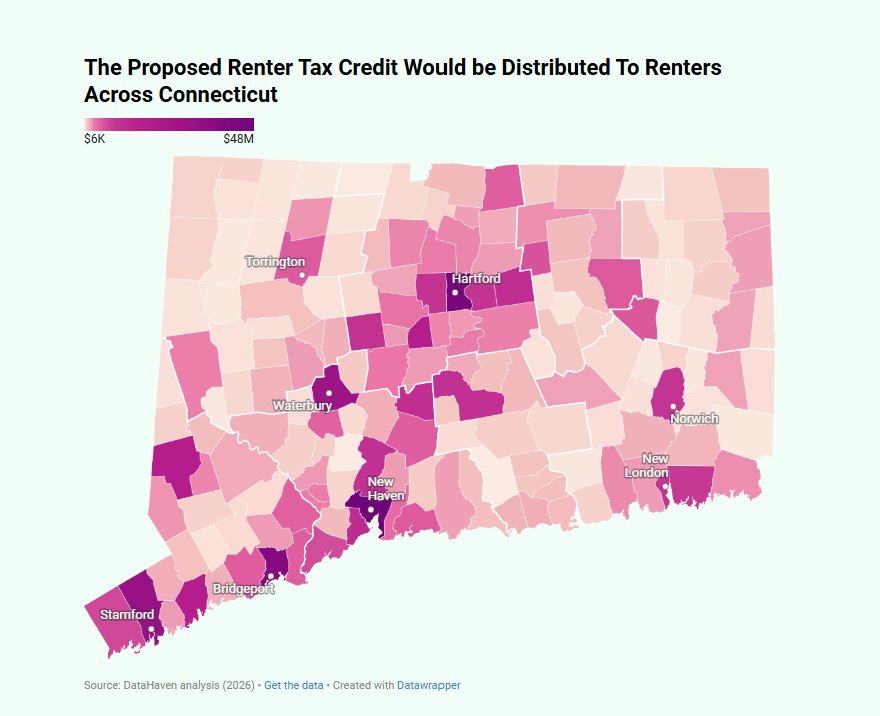
Renters in Connecticut are experiencing the worst housing affordability crisis in decades. A new report by DataHaven explores how a renter’s tax credit could support households facing rising housing costs.
DataHaven analyzed U.S. Census Bureau data to understand how a proposed renter’s tax credit would impact communities in Connecticut. We estimated the total credit and number of households that would be eligible, the average credit that renters would receive, the share of renter households that would be eligible, and how these amounts would vary across towns, legislative districts, and racial and ethnic groups.
Under one proposal, each renter household in most towns would receive a credit between $900 and $1,300 per year, including an average of $1,000 per renter in rural towns, $1,000 per renter in suburban towns, and $1,200 per renter in city centers. At the State House district level, areas receiving total credits of more than $7 million each include District 39 in New London, District 146 in Stamford, District 110 in Danbury, and District 25 in New Britain, in addition to at least two districts in each of the state’s four largest cities.
Join Us: Connecticut Trivia Night (Virtual!)
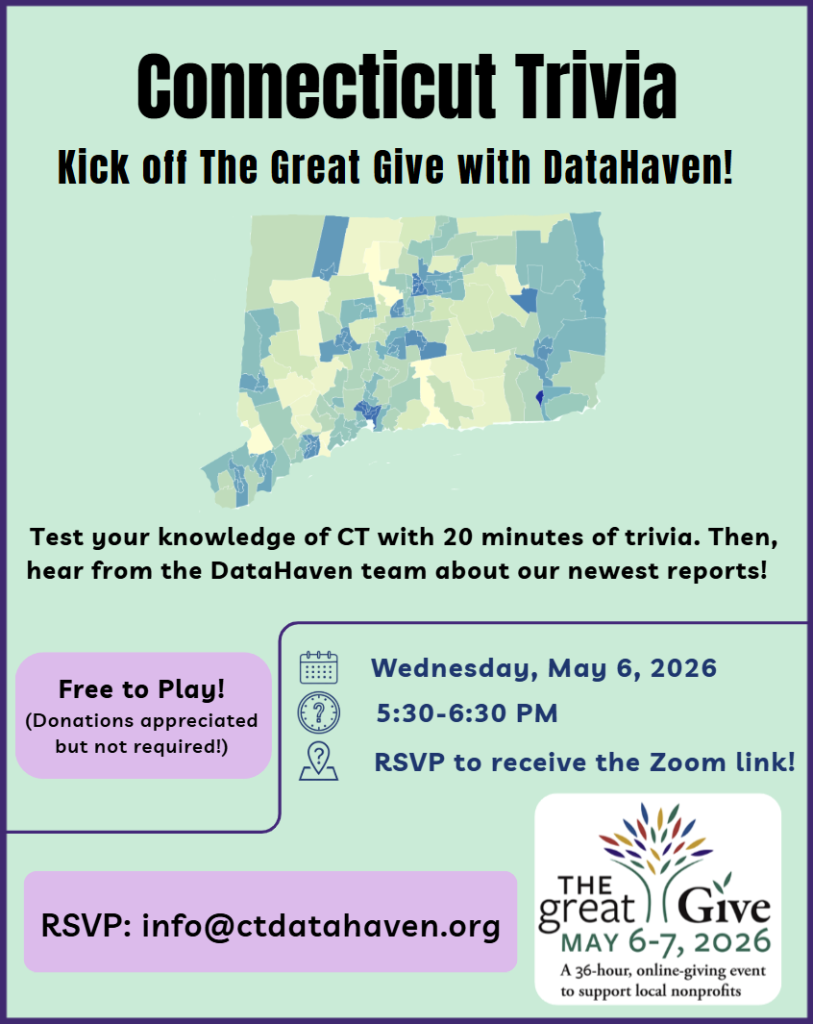
Wednesday, May 6
5:30–6:30 PM
Zoom (RSVP required)
Join DataHaven for a fun and interactive evening of Connecticut Trivia! This free event is open to all and will include:
20 minutes of Connecticut-themed trivia
A short data presentation featuring findings from our newest reports
Prizes for winners, including DataHaven goodies
RSVP: Email info [at] ctdatahaven.org to receive the Zoom link
Help us share the flyer below. Come test your knowledge, learn something new, and help us kick off The 2026 Great Give! Support (optional): https://www.thegreatgive.org/organizations/datahaven
DataHaven in the News
DataHaven’s Executive Director recognized with citywide award for strengthening connections between Yale and New Haven
https://news.yale.edu/2026/04/09/awards-celebrate-those-strengthening-bond-between-yale-and-new-haven
Most Connecticut residents support increased investment in HUSKY and SNAP
https://tcpactionfund.org/blog/most-connecticut-residents-want-to-see-investments-in-husky-and-snap?hs_amp=true
New federal rules may make it harder to access and maintain SNAP benefits
https://tcpactionfund.org/blog/new-rules-will-make-it-harder-to-get-and-stay-on-snap
Darien considers pausing large multifamily developments amid statewide housing challenges
https://www.coastalconnecticuttimes.com/darien-looks-to-pause-large-multifamily-developments-amid-statewide-housing-challenges/
Connecticut has tools available to address its housing shortage
https://www.cbia.com/news/issues-policies/connecticut-tools-housing-shortage
Norwalk ACTS highlights findings from the 2025 DataHaven Equity Report
https://www.nancyonnorwalk.com/norwalk-acts-presents-findings-from-2025-equity-report/
Opinion: The closure of The Pride Center and its broader community impact
https://www.newhavenindependent.org/2026/03/04/opinion-why-the-pride-centers-closure-matters/
Homelessness in Connecticut is rising amid uncertain federal support
https://ctmirror.org/2026/02/27/ct-homelessness-is-up-and-federal-support-remains-uncertain/
Commentary: Addressing homelessness requires addressing housing
https://ctmirror.org/2026/03/17/its-not-complicated-homelessness-is-a-housing-problem-danya/
DataHaven Youth Action Council leads interactive public health and urban planning workshop
https://www.instagram.com/p/DXAiRB4kccv/
DataHaven participates in AAPI data visibility and inclusion convening at the Legislative Office Building
https://www.instagram.com/p/DXZeDL3ERE3/
[Excerpt from Yale News article, 4/9/26]
A group of Yale School of Medicine physicians who introduce New Haven students to potential careers in health care, two local champions behind the city’s growing biomedical and technology sector, and a pair of Yale undergraduates who have helped turn public art into a catalyst for community activism and mentorship are among the recipients of the 2026 Seton Elm-Ivy Awards.
The awards, bestowed annually, honor outstanding efforts by individuals, organizations, or programs to enhance the lives of Elm City residents and strengthen the partnership between Yale and its host city. Elm Awards recognize individuals from the broader New Haven community; the Ivy Awards recognize Yale staff members, faculty, or students.
This year’s Elm Award recipients are Mark Abraham, executive director of DataHaven, a New Haven-based nonprofit that since 1992 has collected and ensured access to data on well-being, equity, and quality of life in the community; Rob Bettigole and Chris McLeod, managing partners of Elm City Ventures, a New Haven-based seed and early venture fund that has supported Yale researchers tackling some of the world’s most pressing challenges; and Dina Natalino, the supervisor for college and career pathways for the New Haven Public Schools.
Ivy Awards went to Leigh Evans, Jay Bonz, and Tatiana Moylan, three Yale School of Medicine faculty members who for more than a decade have introduced New Haven students to potential careers in the health care profession through the Yale Simulation Lab; Kevin Charbonneau, director of the Yale Environmental Health & Safety department; Andrei Harwell, a senior critic at Yale School of Architecture and director of the Yale Urban Design Workshop; Katelyn Wang and Johan Zongo, student leaders of Bright Spaces, a Dwight Hall organization dedicated to youth mentorship through art (Undergraduate Ivy Award); and Collin Edouard, a Ph.D. candidate in Yale’s Graduate School of Arts and Sciences who has built connections with the New Haven community through music and mentorship. (Graduate/Professional Student Ivy Award).
Yale President Maurie McInnis and New Haven Mayor Justin Elicker presented the awards during a ceremony on April 8.
The Seton Elm-Ivy Awards were established in 1979 through the inspiration and support of Fenmore Seton ’38 and Phyllis Seton, who established an endowment at the Community Foundation for Greater New Haven to support the awards ceremony. The first Elm and Ivy awardees were named in 1980.
The citations for this year’s winners follow:
Mark Abraham, Elm Award
“For over 15 years, Mark Abraham has served as a translator between the world of complex data and the lived realities of New Haven residents. As the Executive Director of DataHaven, he has moved far beyond the traditional role of a statistician to become a vital community architect who humanizes numbers. Under his leadership, DataHaven has transformed from a regional data repository into a national model for community-centered research. The centerpiece of this work is the DataHaven Community Wellbeing Survey, a massive undertaking that Mark spearheaded to capture the granular details of life — from economic security and health access to neighborhood trust and safety.
“This survey is not merely a collection of charts; it is a public resource that has leveled the playing field for local nonprofits. By providing high-quality, neighborhood-level data, Mark has empowered dozens of New Haven organizations to secure millions of dollars in federal and private funding by accurately proving the needs of their constituents. Simultaneously, he has become an indispensable partner to Yale University. Yale researchers and students across the Schools of Public Health, Medicine, and Management rely on Mark’s data to ground their academic scholarship in community reality, ensuring that Yale’s research is both relevant and responsive to its neighbors.
“Mark’s career is a testament to the idea that data, when placed in the right hands and used with the right heart, can be a powerful engine for equity and empowerment. Through his work, Mark reminds us that behind every statistic is a neighbor whose story deserves to be heard and whose needs deserve to be met.
“For his visionary leadership in data equity and his commitment to grounding academic research in local reality, Mayor Justin Elicker and President Maurie McInnis present Mark Abraham with an Elm Award.”
[….]
[Excerpt from article by Kelly Prinz, 3/29/26]
The Darien Planning and Zoning Commission is planning to vote on a one-year moratorium for “large multifamily developments,” or projects with 25 or more units.
Jeremy Ginsberg, the town’s director of land use, said there were a few reasons behind the proposed moratorium including a need for the commission to finish its work on the 10-year master plan. In addition, he and commissioners said that the town has had a lot of multifamily housing added in the last few years and they wanted to see the impacts of it on the town.
“I’m mindful of the need for this moratorium,” First Selectman Jon Zagrodzky said at the commission meeting. “The idea of a pause to allow what has been a non-trivial amount of development in town that seems not just to make sense, but to resonate with most residents with whom I speak.”
There would be some exemptions—particularly any projects that come under state statutes like 8-30g as they are governed by a separate set of regulations. But the moratorium comes amid a larger conversation happening across the state about the need for more housing.
A February 2026 report from DataHaven found that the state is “facing a historic housing affordability crisis.” The report noted that the state “ranks dead last nationally in the number of active housing listings for every ten thousand households … second to last in its rental vacancy rate, as of 2024.” In addition, the Connecticut Coalition to End Homelessness found that homelessness in Connecticut rose by 44 percent since 2021.
[….]
The February study from DataHaven found that Darien has seen a 4.7% growth in its number of housing units over the past five years, which is above many neighboring communities—although the overall number of units, 345, is lower. Norwalk saw a 4.1% increase in the number of housing units it has, adding 1,564. Stamford had the highest percentage in the state—a 6.2% increase or more than 3,500 units.
Greenwich added 381 units for a 1.5% increase, Westport added 261 for a 2.5% increase, Fairfield added just under 600 for a 2.7% increase, and Bridgeport added 1,550 units for a 2.6% increase.
The report said that while the number of housing units has increased, it’s not enough to meet the growing needs that Lamont outlined. Citing the 2025 Connecticut Fair Share Housing Study, the report found that there is a shortfall of 120,000 housing units for low-income residents. That study noted the ”overall housing gap is even larger—up to 380,000 units statewide.”
The demand is coming from a few places—people wanting to age in place, workers and families moving into Connecticut, and younger people looking to move out of their parents house, DataHaven found, noting that “average household sizes are also shrinking, as fewer people choose to live with roommates or extended family. As a result, even if the population were to remain steady, the demand for new housing supply would still increase with the rising number of households and the gradual loss of existing housing units.”
The report recommends finding ways to accelerate new housing developments, not pause them, such as by allowing multifamily housing by right in areas around transit and job centers.
[….]
[Excerpt from article by Aidan Lame, 3/26/26]
Recently, Connecticut non-profit DataHaven published an article looking at where housing has been built within the state using the Address Count Listings data, a new product from the Census Bureau.
Previously, we could estimate new construction by analyzing permit data through the Building Permits Survey.
The Address Count Listings expands our capabilities by showing recently completed unit counts as they are added to postal service address rolls.
DataHaven’s analysis illustrates some of the key findings we can get from this new product.
Their research shows that 40,000 new units have been built in the state between 2020 and 2025 with just 10 towns, primarily the largest cities, accounting for 39% of housing.
Overall construction is concentrated in just a few census tracts, highlighting that much of the new housing constructed in the state during that period was in large multifamily developments.
Relative Growth
Our analysis looks to build on DataHaven’s research in two ways.
First, we examine new housing construction in per capita terms to better understand the relative growth in communities across the state, as well as how the state compares to others.
Second, we perform a simple regression to better understand relationships between housing construction and price or population growth.
Both of these contributions will give readers a better understanding of where housing construction is growing fastest, and the broader impact this new housing is having on the respective communities.
[….]
Impact on Prices, Population
In 2025, more than 300,000 people in Connecticut reported being unable to pay for housing, double the 150,000 who reported the same in 2015 [according to DataHaven Community Wellbeing Survey data].
Affordability, therefore, is of central concern to the conversations regarding new housing growth in the state.
[….]
[Excerpt from article by Danya Keene, Annie Harper & Caitlin Ryus, 3/17/26]
According to a recently released report [from DataHaven], the prevalence of unsheltered homelessness – people sleeping in places not meant for human habitation, such as sidewalks, parks, or abandoned buildings – has nearly tripled in Connecticut communities over the last five years, from 294 individuals on a given night in 2022 to 833 in 2025.
This 183% increase is poised to triple again if proposed federal funding cuts to permanent supportive housing are passed.
These proposed cuts threaten housing for 6,000 current Connecticut residents of permanent supportive housing, an established and evidence-based approach to preventing and treating homelessness. Indeed, at the end of the day, Connecticut’s current rise in homelessness is a housing problem. Solving it requires investments in safe, stable, affordable housing, as well as subsidies that help keep people housed in an increasingly unaffordable housing market.
[….]
Here in Connecticut, recent data confirm that unaffordable housing is a key driver of unsheltered homelessness. The recent report cited above indicates that affordability was a primary cause of homelessness for the majority of individuals entering Connecticut shelters last year. Close to 30% of those entering Connecticut shelters reported that the primary cause of losing housing was “expenses exceeded their income.” Close to 25% reported that they became homeless after exhausting their options to stay with other people (doubling up). Another 13% reported that eviction was the primary cause, suggesting a need to enhance eviction protections for Connecticut tenants through rental assistance programs and policies that expand just cause eviction such as the recently discussed bill, SB257.
The numbers of people currently experiencing homelessness due to affordability constraints are only the tip of a much larger iceberg. According to a recent report 48% of renter households in Connecticut are rent-cost burdened – meaning that they spend more than 30% of their monthly income on rent – and 25% are severely cost-burdened, spending more than 50% of their income on rent.
[….]
Nationally, fewer than 1 in 4 eligible households receive HUD rental subsidies such as vouchers or project-based housing that reduce a tenant’s rent to 30% of their income. In Connecticut, tens of thousands of households are waiting for these subsidies with wait times often stretching more than 5 years. While households wait for subsidies and struggle with unaffordable rents, even a temporary financial shock (a medical bill, reduced hours at work, or childcare disruption) can push them into homelessness. And when individuals do fall into homelessness, as many as 1 in 4 are turned away from services due to capacity constraints.
If we accept that homelessness is fundamentally driven by housing affordability, the immediate solutions are clear: expand permanent supportive housing; invest in rental assistance; strengthen eviction protections, and fully fund our homelessness response system, so that temporary hardship does not become prolonged homelessness. What remains is the political will to act.
[Excerpt from news report by By Sarah F. Griffin, Ashley RK Smith, March 11, 2026]
NORWALK, Conn. — Norwalk ACTS presented findings from the 2025 Equity Report by DataHaven during its quarterly convention on Tuesday, highlighting disparities in housing, education, and language access among Norwalk residents.
The event brought together community leaders, educators, and residents to collaborate on issues including early childhood development, social-emotional health, and college and workforce readiness, according to Norwalk ACTS.
DataHaven presented the findings of the Norwalk 2025 Equity Report during the convention.
Jesse Buccolo, deputy director of Norwalk ACTS, said the quarterly convenings are meant to help the community use data to understand local challenges.
“Our quarterly convening is about helping our community use data to better understand how children, youth, and families in Norwalk are doing and what we can do together to improve outcomes,” Buccolo said in a statement.
Norwalk 2025 equity report findings
The Norwalk 2025 Equity Report, published in December, was designed to inform local efforts to improve community well-being and racial equity.
The report compares demographic and socioeconomic data from Norwalk with statewide figures and with Public Use Microdata Area (PUMA) 0920903, a Census-defined region that includes Norwalk and Westport.
Demographics
Norwalk has about 91,000 residents, and the city’s population has grown about 6 percent since 2010. About 57 percent of residents are people of color, compared with about 37 percent statewide.
Roughly 30 percent of Norwalk residents are foreign-born. The largest immigrant populations in the city come from Colombia, Mexico, and Jamaica, according to the report.
The report also found that about 17 percent of residents age 5 and older speak English less than “very well,” a factor that can affect access to services such as education, health care, and employment.
Housing
Housing affordability emerged as one of the major issues highlighted in the report.
About 40 percent of Norwalk households are considered cost-burdened, meaning they spend at least 30 percent of their income on housing costs.
Homeownership rates also vary significantly across racial groups. About 69 percent of white households in Norwalk own their homes, compared with 42 percent of Black households and 38 percent of Latino households.
Nearly half of renter households in Norwalk are cost-burdened, compared with about one-third of homeowners.
Buccolo said the report is intended to ensure the data reflects the lived experiences of residents.
“Behind every data point is a real person, whether that is a child, a young person, a parent, or a caregiver, and our goal is to make sure those lived experiences guide how schools, nonprofits, healthcare providers, and city leaders work together,” he said.
Education
The report also examined education outcomes and school demographics.
During the 2024–25 school year, about 11,473 students were enrolled in Norwalk Public Schools. About 23 percent were English language learners, and roughly 52 percent qualified for free or reduced-price meals.
Overall, about 93 percent of Norwalk public high school seniors graduated within four years, according to the report.
Economy and income
Norwalk’s median household income is about $105,301, higher than the statewide median but lower than that of other towns in the regional comparison area.
The city is home to about 39,800 jobs, with the largest share in the health care and social assistance sector.
However, the report notes that disparities remain across racial and ethnic groups, with households led by Black and Latino residents generally reporting lower incomes than white or Asian households.
Health
The report also highlights health disparities tied to economic and social conditions.
About 56 percent of Norwalk adults report being in excellent or very good health.
The report notes that factors such as housing stability, income, language access, and transportation can influence health outcomes.
In 2024, eight Norwalk residents died from drug overdoses, according to the report.
Civic life and community
Survey results included in the report show mixed views about local civic life.
About 86 percent of Norwalk adults said they are satisfied with their area of residence. However, only about 48 percent said their local government is responsive to residents’ needs.
Voter turnout in the most recent municipal election was about 37 percent of registered voters, according to the report.
Environment
The report also examined environmental factors affecting quality of life.
About 75 percent of Norwalk adults report having stores, banks, and other services within walking distance of their homes, and about 67 percent say there are safe places to bike in their neighborhoods.
Norwalk’s tree canopy covers about 25 percent of the city’s land area, with an additional 14 percent identified as potentially plantable space. Trees in the city remove an estimated 345,000 pounds of air pollutants each year, according to the report.
Buccolo said the report is also intended to help organizations coordinate responses across education, health care, and community services.
“When partners across different systems come together around shared data, it helps us align efforts and move toward the kind of systems change needed so every young person in Norwalk is on a pathway to economic mobility,” he said.
About Norwalk ACTS
Norwalk ACTS’ mission is “to collectively transform systems by ensuring resources, policies, practices, and power structures actively dismantle racism and drive equitable outcomes for every Norwalk child and young person,” according to the organization.