
You have arrived at DataHaven, where we provide data for community action.
We collect, interpret, and share public data to empower communities to make effective, informed decisions. We provide a public service by working with a wide variety of partners to develop innovative reports, tools, and technical assistance programs that make this information more useful.
We belong to national, statewide, and local efforts to the promote the use of local information in policymaking and community development.
Our website is our headquarters.
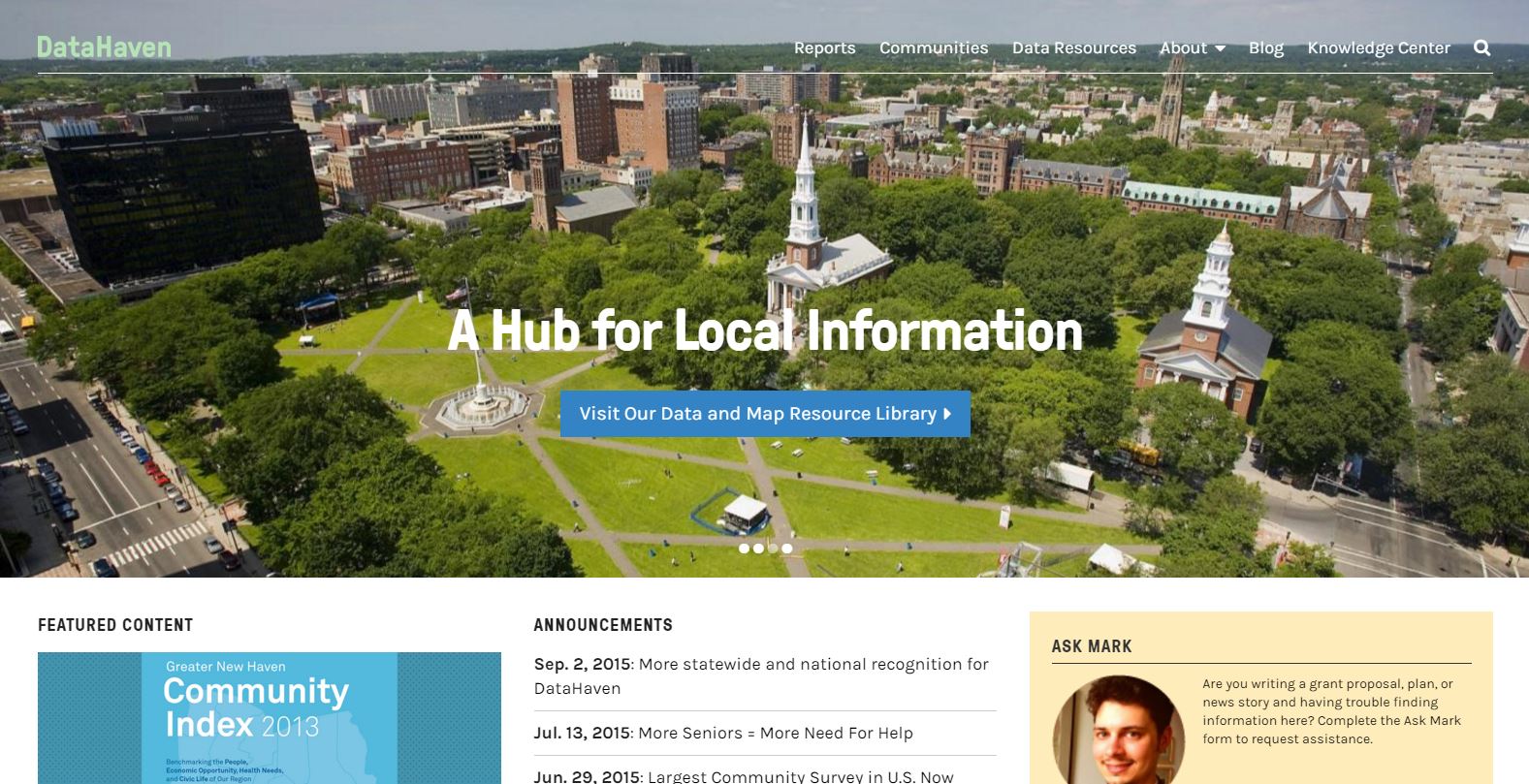
If you have not visited before, welcome! Here, we describe local communities, publish our extensive research, share relevant resources from our collaborators, and promote innovation in our field.
If you have used our site in the past, welcome back! You probably noticed that things look a little different.
Since our founding twenty-five years ago, we have cultivated and shared a repository of valuable quality of life indicators. Yet in recent years the amount of accessible public data has dramatically increased. In the past, sites like ours were envisioned as places where you could go to find any data you needed. However, with the exponential growth of available data and with our state and federal government agencies now hosting multiple different websites as open data repositories (including the Connecticut Open Data Portal for certain state government datasets), having a single “data warehouse” is no longer a feasible objective for anyone.
In the Age of Big Data, information is available on nearly everything (even the number of coffee shops in your town), and the amount of it doubles every year. Sifting through tens of thousands of potential data sources for the most relevant, quality data can be daunting.
That’s where we come in. As data stewards, our local, state, and national partners task us with selecting and maintaining the most important information for the communities we serve, and sharing it with you in relevant, useful mediums.
We have designed our new website to do just that — first, to direct you to the most meaningful information. Second, to serve as a portal in which the general public can easily see what we do and what we have published, and request our help. Ask us for what you need and we will find it or direct you to the source.
The new website renovation will simplify your navigation to the resources you need.
We’ve reorganized so that the resources from our previous website are easier to find and to use:
- Visit Communities to access key indicators about regions, towns, and neighborhoods in Connecticut, in a friendly new “Community and Town Profile”-type format.
- Our reports, tagged by category, are downloadable and contain in-depth analyses of issues our regions confront.
- On our new Data Resources page, you can explore the breadth of our curated collection of information, which covers many issues in many formats. Depending on your need, you can search this library by issue category, resource type, or community. In addition to our published reports, you will find data sets, including documents from our Community Wellbeing Survey, an indicator map gallery, and links to external resources.
- The Knowledge Center catalogues FAQs, data guides, and miscellaneous information based on public request.
Moving thousands of pieces of information from our old website, established in 2003 as one of the first of its kind in the United States, has taken time and remains a work in progress. Please stay tuned as we gradually re-populate these pages with new data and requests; some of the information that we have archived from 2003 to 2014 will be accessible in the meantime. More than ever, it would be impossible for us to post more than a tiny fraction of the data that we work with, so contact us if we can help.
 As always, you can follow news about us and coverage of our work on our Connecticut data blog, or take a minute to learn about DataHaven, our staff and board, and our partners.
If in doubt as you search our website for a specific item or topic, use the top bar to guide you to each of our resource pages or to search the site for what you need. All of our data resources are tagged by category, key terms, and community. And if you still cannot find what you need or if you require more assistance, we encourage you to reach out to us.
We now invite you to explore our new website, discover meaningful information, and apply it. We think you will like the changes!
Thanks for stopping by,
Mark Abraham, Executive Director
Mary Buchanan, Project Manager
[Excerpt] A new study shows that growing economic inequality is taking root in Connecticut.
[Excerpt] From 1980 to 2013, the percentage of Connecticut residents living in neighborhoods of concentrated wealth or poverty grew by 30 percent, according to a new analysis from DataHaven.
[Excerpt] A positive influx of immigrants fed the rapid growth, even as the city lost native-born residents. By the latest tally, 17 percent of New Haven’s 130,000 residents are immigrants. Their origins, ages, skills, citizenship statuses, and personal stories are different, but their overall impact is clear: “The surge of immigration in recent years shows us yet again how important [immigrants are] to the growth and success of our community,” according to William W. Ginsberg, President & CEO of The Community Foundation for Greater New Haven. As seen in other cities, the report shows how immigrants contribute to New Haven’s resilience, revitalizing the community through economic and social investment.
Immigrants help sustain a dynamic workforce in Greater New Haven. Foreign-born people are more likely to be employed than native-born residents; further, there are two high-skilled immigrant workers for every low-skilled immigrant worker. All these people contribute to the local economy by paying taxes, supporting businesses, and increasing trade with foreign markets.
The New Haven region study also shows that immigrants are frequent participants in local real estate, institutions, and economy – often at higher rates than native-born people. For example, naturalized citizens living in the city of New Haven are more likely to own a home (43 percent of households) than native-born citizens (32 percent). Since 2005, overall public school enrollment has decreased in Connecticut and in the Greater New Haven region, but it has grown among foreign-language speakers. Foreign-born people are substantially more likely than native-born people to own a business.
The World Health Organization has selected Greater New Haven as one of 15 urban areas worldwide to pilot a planned age-friendly city indicator guide.
The guide will be designed to measure areas where cities and communities can better adapt to the needs of older people. Mark Abraham, executive director of Data Haven, is collaborating on the project. “The World Health Organization has a framework that looks at the physical infrastructure,” he said, “like the layout of streets and communities, and the social engagement, like how effective government is at responding to the needs of seniors. [It also looks at] how engaged seniors are in their communities.”
[Excerpt] How easy is it to live in the New Haven area if you’re a senior? How well can you get around, engage in social activities and civic duties or keep a good job and secure health care?
[Excerpt] After decades of suburban sprawl, a new report shows that more jobs — and better, higher-paying jobs — are flocking to our nation’s cities, even as peripheral areas see their job base erode. Here in Connecticut, employment growth in dense city centers like New Haven and Hartford is once again driving our state’s overall economic vitality.
[Excerpt] In recent years, job growth in downtown centers nationwide has far outpaced growth in surrounding suburban areas, according to a widely-cited report released this week by the City Observatory. According to a DataHaven analysis of the Census dataset used in the report, New Haven and Hartford are experiencing a similar shift.
[Excerpt] Immigrants contribute to the economic, cultural and social well-being of the Greater New Haven region. That according to a recently released report, “Understanding the Impact of Immigration in Greater New Haven,” issued by the Community Foundation for Greater New Haven, found that as of 2012, one in eight residents of the 20-town region is foreign-born, coming from all corners of the globe. About half are naturalized US citizens; the rest are legal permanent residents, legal temporary residents or undocumented immigrants.
[Excerpt] If Greater New Haven is thriving, the region’s rapidly-growing immigrant population is a key reason, according to a new research study. The report, entitled Understanding the Impact of Immigration in Greater New Haven, compiles data from federal, state and local government agencies, as well as information generated locally by DataHaven and The Community Foundation of Greater New Haven.