
Declining Coverage and Rising Premiums: The Effects of H.R. 1 and the Expiration of Premium Credits on Medicaid and Marketplace Health Insurance in Connecticut Towns and Legislative Districts
By Andrew Carr (DataHaven) and Karen Siegel (Health Equity Solutions)

Executive Summary
House Resolution 1, also known as the Trump Administration’s “One Big Beautiful Bill Act”, has had major consequences for health care access in the United States. By introducing work reporting requirements and copayments for HUSKY D1 and restricting Medicaid eligibility for some immigrants, the policy changes in H.R. 1, combined with recent cost increases in the health insurance marketplace, are nearly certain to cause a spike in uninsurance rates.2 Causal studies show that loss of health insurance results in higher mortality rates.3
Our report examines the projected town- and state legislative district impacts of H.R. 1 and other recent federal policy changes on enrollment in HUSKY (Medicaid) and Access Health Connecticut—the state health insurance marketplace.
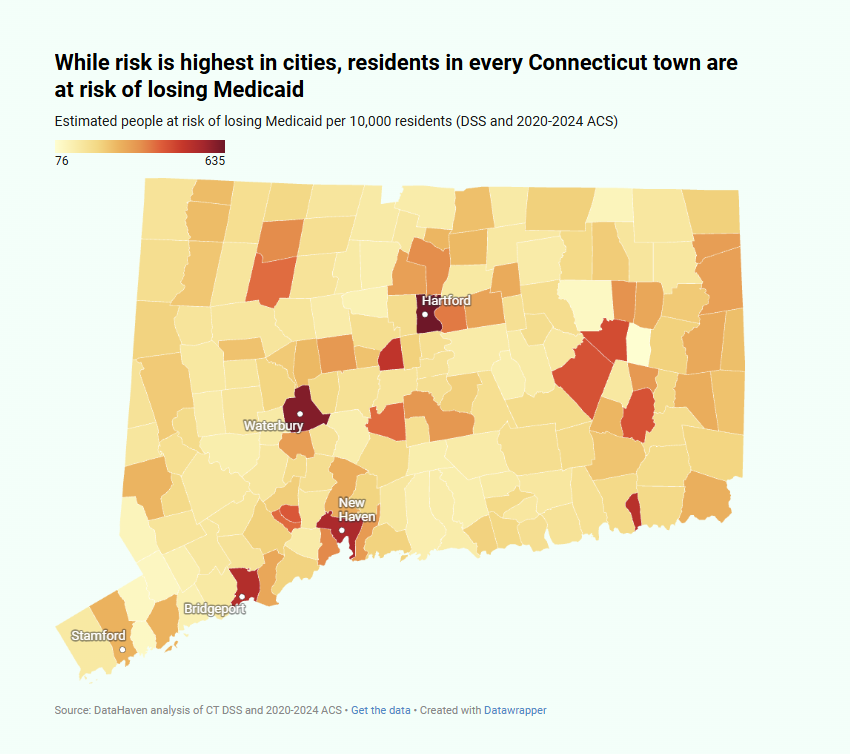
Medicaid eligibility changes and work reporting requirements are projected to result in over 100,000 HUSKY members losing coverage.4 These coverage losses will be felt in every municipality across the state, with the largest impacts occurring in cities with concentrated populations of low-income families and immigrants.
On Access Health, however, we find that less populous towns and towns in western Connecticut have the highest shares of people who will see their premiums increase. These towns have higher shares of people enrolled through the marketplace and smaller shares of lower-income enrollees who are eligible for Covered Connecticut, HUSKY, and federal subsidies.5 Finally, we estimate the added premiums the residents of Connecticut towns will pay for coverage on Access Health CT due to the expiration of enhanced premium tax credits.6 Wealthier towns, towns with the most marketplace enrollees, and towns in southwestern Connecticut will see the largest total premium increases.
We conclude with a discussion of the policy implications of our findings, including potential policy solutions to provide options for people who have lost coverage in 2026 or who are expected to lose coverage in 2027.
Additional Interactive Maps and Downloadable Data
Scroll down past this section to continue reading the full report.


Spreadsheet with DataHaven estimates for all geographic areas
DataHaven produced an Excel spreadsheet containing the data used in this report, which may be downloaded here.
The Impact of the H.R. 1 Work Requirements on Medicaid Enrollment
One of the most significant changes H.R. 1 makes to health care coverage is the introduction of work reporting requirements. These target low-income 19–64 year-old adults without dependents, a group often referred to as the “Medicaid expansion” population and known as HUSKY D in Connecticut. Expansion adults, who became eligible for Medicaid after the passage of the Affordable Care Act in 2010, can receive Medicaid through Connecticut’s HUSKY D program., HUSKY D enrollees will be required to fulfill work reporting requirements starting on January 1, 2027. HUSKY D enrollees will also be required to verify their eligibility twice each year instead of once beginning on January 1, 2027.
The work requirements will cause coverage losses by placing administrative burdens on people who are eligible for Medicaid. The state estimates that the work reporting requirements will put 108,000 Connecticut residents at risk of losing HUSKY D coverage. This estimate is based on the share of HUSKY D enrollees whose income or exemptions from the requirements cannot be automatically established using data sources available to the HUSKY program. These enrollees are at risk of losing coverage if they do not complete paperwork even though most of them are either working or exempt from the requirements. Administrative barriers to government services have a disproportionate impact on Black, Latino/a and other people of color, an effect that can be attributed to multiple forms of systemic racism, including administrator bias, residential segregation, and labor market discrimination.,,
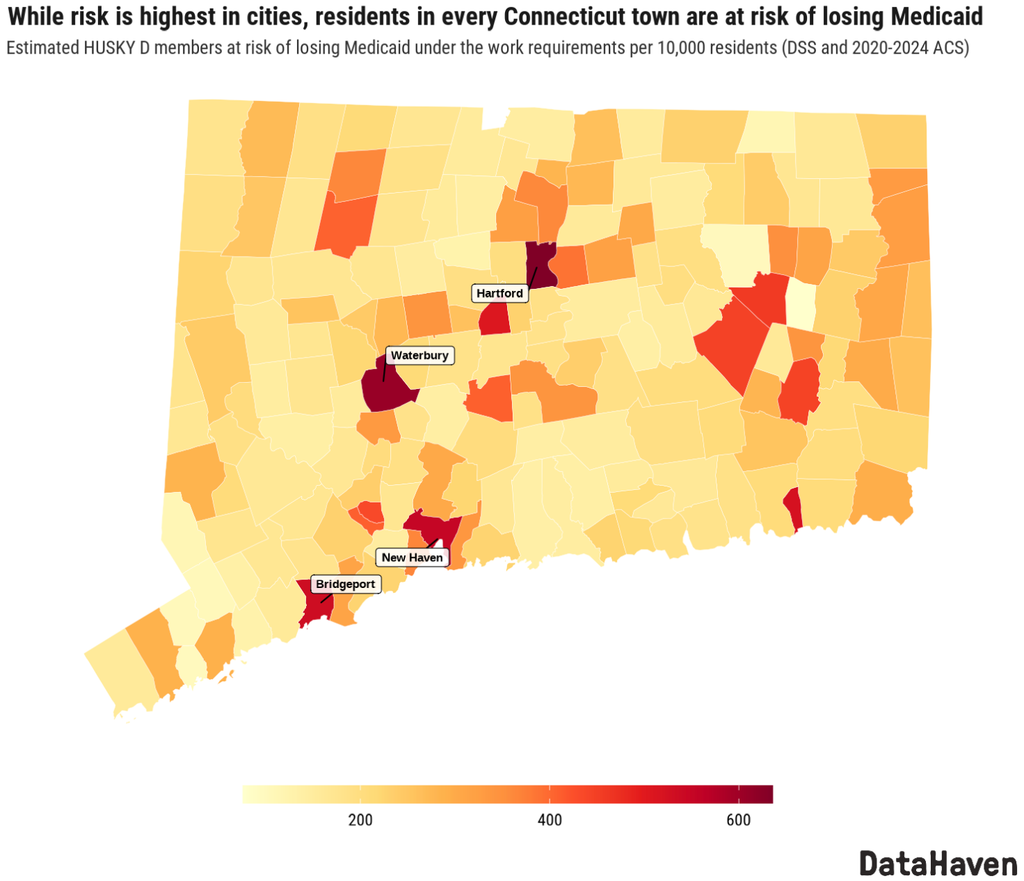
The map above, and the interactive maps in the top section of the report, shows the distribution of residents at risk of losing HUSKY D due to the work reporting requirements (see Methods and Limitations for more information on how town risk rates were estimated). These findings support our report from last year, Coverage at Risk: Projected Losses in Medicaid and Access Health CT by Town and Community, which predicted that every Connecticut town would see coverage losses and that large cities would bear the brunt of the effects of H.R. 1 on HUSKY. The towns with the highest risk per ten thousand residents are Hartford (635), Waterbury (608), New Haven (550), and Bridgeport (536). These are four of the five largest cities in Connecticut. The statewide rate is 298 per ten thousand residents. A handful of smaller cities and large towns, including New Britain, New London, Windham, Norwich, and Ansonia, also have above-average rates of at-risk residents.
Towns with high rates of HUSKY D enrollment have higher rates of people at risk of losing Medicaid due to the work requirements. In the ten towns with the highest rates of HUSKY D enrollment, the risk of losing Medicaid is estimated at 535 per 10,000 residents, compared to 231 per 10,000 for the rest of Connecticut. While all Connecticut towns are home to Medicaid enrollees, these towns tend to have elevated poverty rates and, relatedly, high levels of enrollment across all Medicaid programs.
The Impact of Eligibility Changes on Medicaid Enrollment
In addition to the work requirements, H.R. 1 includes provisions that deny Medicaid access to some lawfully present immigrants such as asylees, refugees, and parolees. This rule went into effect on October 1, 2026. These groups of immigrants will also become ineligible on January 1, 2027 for federal subsidies on Access Health. H.R. 1 also denied access to federal subsidies on Access Health to certain lawfully present immigrants living below the poverty line. The loss of these credits went into effect on January 1, 2026, making approximately 5,300 immigrants ineligible for Covered Connecticut.
The state estimates that 3,200 people were removed from HUSKY coverage in October of 2026. We used this number and Census data to estimate the distribution of those who lost coverage across Connecticut towns. Many cities, including Bridgeport, Waterbury, Hartford, and Danbury, have the highest shares of people who are at risk of losing their health care due to the new mandates to deny access to health care to immigrants.
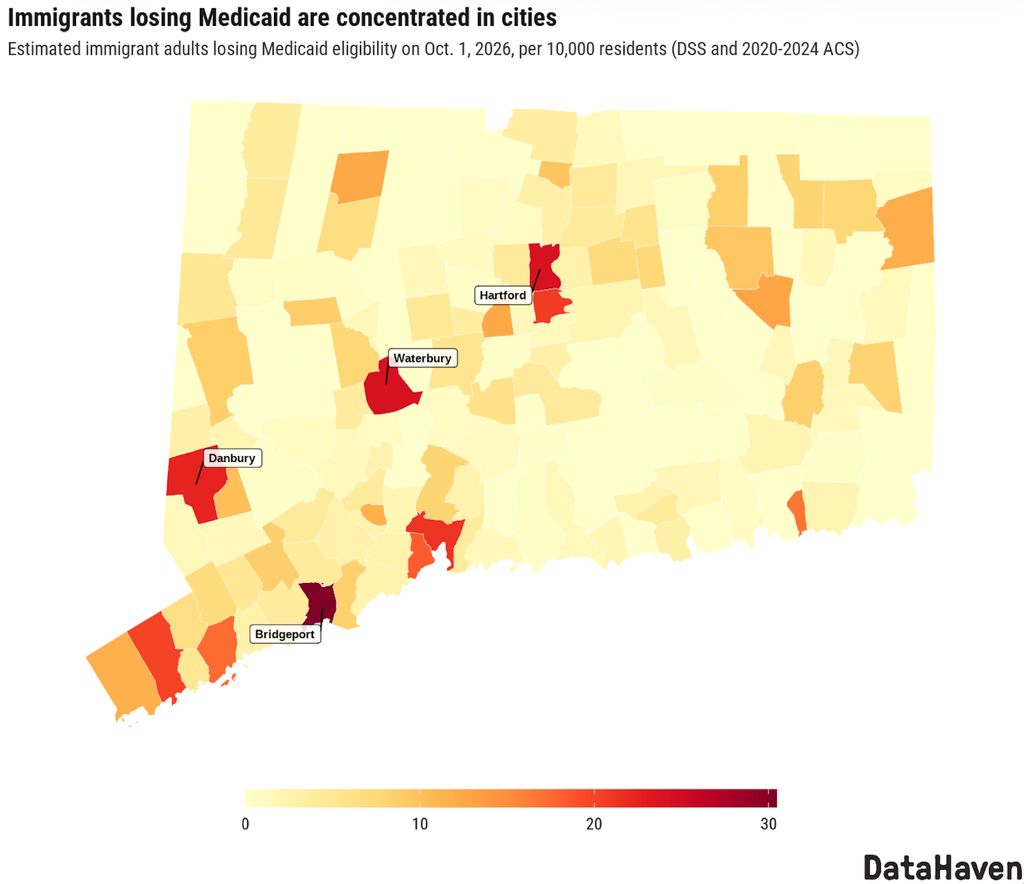
The map above shows the distribution of immigrants who became ineligible for HUSKY per 10,000 residents. The four towns with the highest rates of ineligible immigrants per 10,000 residents are Bridgeport (30), Waterbury (24), Hartford (24), and Danbury (22). Pregnant people and children with impacted immigration status will remain eligible for HUSKY coverage.
As noted above, the people impacted by this policy change will also be denied access to federal subsidies on Access Health CT by H.R. 1 beginning in 2027. As a result, for immigrants who lost HUSKY and who do not have insurance through their employer, unsubsidized (and unaffordable by ACA standards) coverage on Access Health will be the only available coverage option.
Impacts on Access Health Connecticut: Expiring Premium Credits, Marketplace Enrollment, and Total Premiums
Recent policy changes will also impact people enrolled in the state health insurance marketplace, known as Access Health Connecticut. Those enrolled in marketplace insurance are paying more in premiums due to the expiration of the enhanced premium tax credits. Although the state government created a temporary relief fund to partially subsidize these credits in 2026 and extended this fund to 2027, this support is only available to Access Health enrollees in certain income ranges., When this relief expires in 2028, premiums will increase. People making more than 400 percent of the federal poverty level will pay several hundred dollars more per month for marketplace health insurance. Premiums on Access Health Connecticut were already increasing each year due to medical inflation. These changes will prompt many to switch to cheaper plans or disenroll entirely.
The expiration of the enhanced premium tax credits also increased the financial burden on Connecticut. The state estimated in July 2025 that continuing the Covered Connecticut program, which subsidizes marketplace insurance for people making less than 175 percent of the federal poverty level, would cost the state an additional $30 million annually. For 2026 and 2027, this increased funding was provided through Temporary Premium Assistance.
Additional factors will create administrative burdens and drive cost increases for Access Health enrollees in the years ahead. Recent federal policy changes are projected to further erode coverage rates by introducing new rules that will make enrollment more complex. Further, since people who are less healthy are more likely to pay for more expensive plans than people who are generally healthy, insurance companies estimate that their costs per person will increase as the enrollee population decreases. This will result in higher premiums.
The dramatic increase in premiums for some Access Health enrollees due to the expiration of enhanced premium tax credits has already had an impact. Enrollees in households earning more than 400 percent of the FPL were more likely to buy lower value plans with higher deductibles and to drop their coverage after a few months in 2026 than in 2025. Higher out-of-pocket costs result in people delaying or skipping necessary health care.
Our report examines the consequences of rising premiums for Access Health enrollees. We used data from Access Health to estimate the number of people at risk of experiencing premium increases and the distribution of this population across Connecticut towns. The at-risk population includes anyone enrolled in the marketplace on a previously subsidized plan whose income is above 175 percent of the federal poverty level (see Methods and Limitations for details on how the cost of the expired credits was calculated).
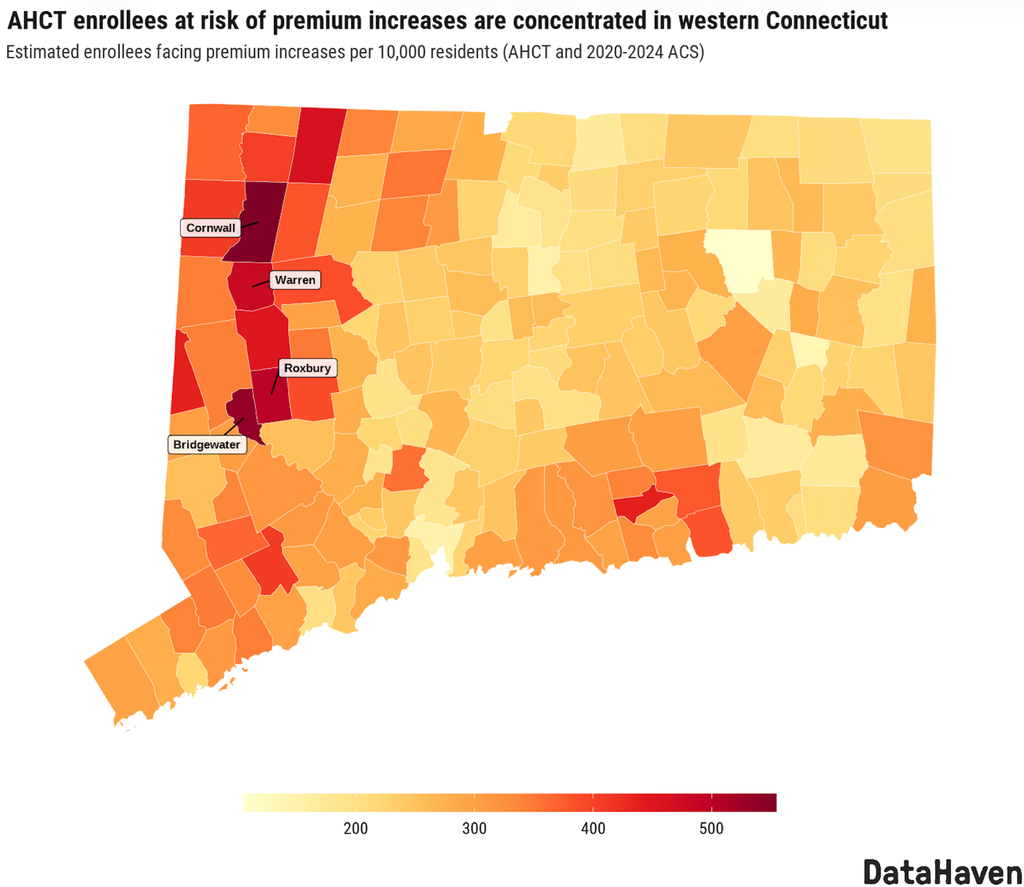
The map above shows the rate of marketplace enrollees at risk of having their premiums increase per 10,000 residents. Many of the towns with the highest rates of premium increases are smaller and located in the western part of the state. The towns with the highest rates include Cornwall (554), Bridgewater (535), Roxbury (500), and Warren (480). These towns have high levels of marketplace enrollment. Of Connecticut’s 169 towns, they have the 7th, 19th, 3rd, and 18th highest shares of self-employed workers. Self-employed workers are roughly three times as likely as private-sector employees to be enrolled in the marketplace. The towns in this region skew older, and older people are more likely to be self-employed. Many self-employed people in this area who have marketplace coverage work in professional services, real estate, and construction.
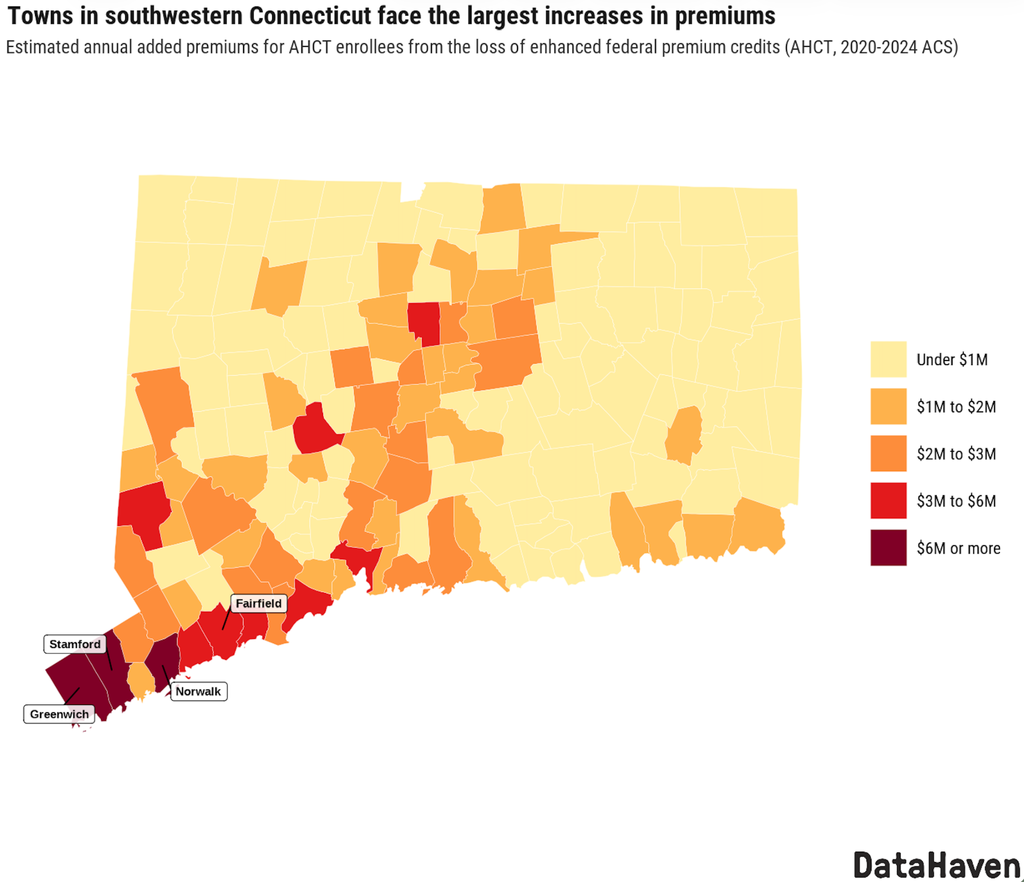
We also used data on marketplace enrollment by income band to estimate the aggregate dollar amount of premium increases by town. The map above shows the distribution of premium increases in 2027 across Connecticut towns. Southwestern Connecticut has some of the towns with the largest premium increases. Stamford alone will lose over $8 million in federal support for premium costs in 2027. Towns with the most Access Health enrollees tend to have the largest total premium increases. Another important factor is the share of higher-income enrollees. For instance, wealthy towns, such as Darien and New Canaan, have higher premium increase costs due to their higher shares of Access Health enrollees who make more than 400 percent of the federal poverty level.
These maps assume that Access Health enrollees remain enrolled on the same plans after these cost increases take effect. We do not account for enrollees who switch to lower cost health plans with less coverage or disenroll from Access Health. In addition to a smaller number of enrollees leading to higher premiums for people who remain enrolled in the marketplace, buying down and disenrollment will create new costs, both to Connecticut residents in the form of negative health outcomes and to the state and health care providers as rates of uncompensated care increase.
Discussion and Policy Implications
Connecticut residents face a growing affordability crisis. The costs of many basic needs, including health care, housing, energy, and childcare are rising. Recent policy changes to HUSKY and Access Health will only add to this problem, transferring more of the costs of these programs to those who depend on them. These policy changes also mean less federal funding and more expenses for the state: One projection from KFF estimates that Connecticut will receive $11 billion less in federal funding over the next ten years in Medicaid alone. Even without a state subsidy for health insurance or a state food assistance program, implementing work reporting requirements and eligibility changes in HUSKY and the marketplace will cost the state tens of millions of dollars.
Our findings speak to the broad geographic scope of these changes. While H.R. 1’s Medicaid provisions will disproportionately impact people in Connecticut’s cities, a meaningful share of residents in all Connecticut towns will lose Medicaid as a result of both the work requirements and immigrant restrictions. The expiration of enhanced premium tax credits will also impact residents in all Connecticut towns. The cuts will have a greater impact on suburban residents, particularly in the western part of the state.
In Connecticut’s large cities, including Hartford, Waterbury, Bridgeport, and New Haven, the work requirements place more than 500 people per 10,000 residents at risk of losing their Medicaid coverage. The immigrant provision puts an additional 22 to 30 people per 10,000 residents at risk in Hartford, Bridgeport, Danbury, and Waterbury. Those who lose their HUSKY coverage—whether due to work reporting requirements or eligibility rule changes— will not be able to access subsidies on Access Health. As a result, they will have no option of enrolling in affordable health coverage.
For current Access Health CT enrollees, the increased cost of remaining insured will prompt many to drop their health insurance or to enroll in plans with high out-of-pocket costs. This will lead to worse health outcomes: uninsured people and people who must pay deductibles and copays are less likely to seek preventive medical care, which is critical for detecting health problems early and treating them before they become severe. Disenrollment from Medicaid and marketplace coverage also places financial strain on community health centers and hospitals because they will have increased levels of uncompensated care. There are widespread reports of health industry workers being laid off in anticipation of the rise in uninsurance and loss of funding by health care institutions in the year ahead.
Policymakers and other community leaders must act now to provide options for those who have already lost their coverage in 2026 and to mitigate the substantial loss of health coverage expected in 2027. While the uninsurance crisis is growing rapidly, health coverage has become significantly less affordable over the past decade. Long-term policy solutions that ensure access to health care for all of Connecticut’s residents are necessary for the health and economic wellbeing of Connecticut residents, the state, and our health care providers.
Sustainable solutions include:
1. Adopting a basic health program in place of Covered Connecticut;
2. Creating a state-run health insurance program for people who cannot access health insurance through HUSKY, Access Health, or their employer;
3. Controlling health care costs and making provider reimbursement more fair by tying Medicaid rates and/or rates from the state employee health plan to a percentage of Medicare rates;
4. Protecting low- and middle-income families who are uninsured from medical debt by strengthening hospital financial assistance policies;
5. Extending state subsidies for Access Health CT coverage;
6. Rebalancing Medicaid provider rates to reflect the cost of care and provide fair reimbursement regardless of the size of the health system;
7. Relieving the administrative burden that the work reporting requirements introduced by H.R. 1 impose on those who remain eligible for Medicaid by increasing outreach to impacted members. The state has created a website, https://medicaidmattersct.org/, that people can visit to learn whether Medicaid eligibility changes apply to them. Connecticut residents can use this resource to prepare for the additional paperwork required to remain on Medicaid. Connecticut’s Community Action Agencies stand ready to assist those who must follow the new work reporting rules in renewing their HUSKY D benefits. Yet, more help is needed. The state should increase its investment in outreach to support HUSKY D members.
Methods and Limitations
Acknowledgments
We thank Mark Abraham from DataHaven, Rosana Ferraro from UHCFCT, and Katherine Villeda from Husky for Immigrants, for reviewing this report. We are also grateful to the staff at Access Health CT, CT DSS, and the U.S. Census Bureau for providing the publicly-available data used to create this report. We also thank the individuals and organizations that plan to use the data in this report to inform their policymaking and advocacy work in Connecticut.
Medicaid
To estimate the distribution of people at risk of losing Medicaid across Connecticut due to the new work requirements, we first estimated each town’s at-risk share of HUSKY D recipients. These are the shares of recipients who, according only to 2025 data available to the state, are not exempt due to age, Medicare enrollment, disability or SSI, or having a child under 14, and have not met the requirements based on wage records or school enrollment data. The state presented data to the Medical Assistance Program Oversight Council (MAPOC) showing at-risk shares for twelve towns. We plotted the at-risk shares and median household income for these 12 towns on an XY plane. We then fitted a line through these points. The fitted y-coordinates represent the at-risk share estimates for the other 157 towns. These points were shifted so that the average at-risk share among these 157 towns is 61 percent, the actual share based on the MAPOC report. The plot below visualizes this.
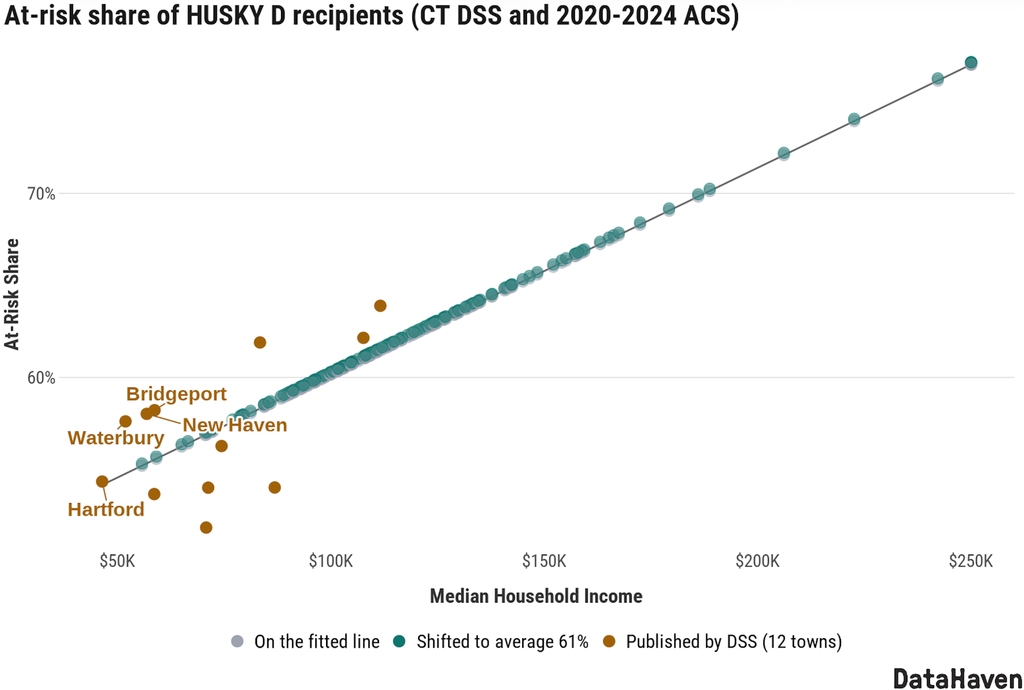
These at-risk shares were multiplied by the number of HUSKY D recipients in each town and rescaled so that the total at-risk recipients across all towns sums to 108,000. Finally, to get the number of at-risk residents per 10,000 residents, we used town population counts from the 2020–2024 American Community Survey.
The main limitation of our approach is that each town’s at-risk share is a modeled estimate. The plot above shows that actual at-risk shares deviate from the fitted estimate. The mean absolute error for the twelve towns is 2.6 percentage points. The mean absolute error of the other 157 towns could be larger than this. MAPOC publishes a map with towns’ at-risk shares in ordered bins. We validated our linear interpolation estimates against this map. About 75 percent of our estimates fall in the correct bin. Although this method is imperfect – as evidenced by the variance of the 12 actual shares around the fitted line – it has little influence over the final results, which are primarily based on the share of HUSKY D enrollees in each town.
The fitted at-risk shares account for certain exemptions and compliance, including wage records, school enrollment, disability, age, and Medicare. They do not account for other exceptions and exemptions including having met SNAP work reporting requirements, having a VA disability rating, being a caregiver, or having a medical or mental health condition limiting the ability to work. These factors are accounted for at the state level, when the town estimates are rescaled so that the total at-risk recipients sums to 108,000.
Immigrant Medicaid Eligibility
To estimate the distribution of the estimated 3,200 immigrants who lost coverage across Connecticut towns, we used the American Community Survey to obtain town-level estimates of the number of non-citizens living below the poverty line. We divided the 3,200-person estimate across towns based on towns’ shares of non-citizens living below the poverty line. This represents the number of people in each town at risk of losing HUSKY coverage due to eligibility changes in H.R. 1. This amount was divided by town population and multiplied by 10,000 to get the rate per 10,000 residents.
Access Health CT
To estimate the share of each town’s residents whose marketplace insurance premiums will increase, we used data provided to Health Equity Solutions by Access Health on the number of Access Health recipients in 2026 by postal city and income bin. The at-risk population includes all enrollees with incomes above 175 percent of the federal poverty level who had received a credit before the enhanced credits expired. Those with incomes below 175 percent of the federal poverty level are eligible for a state subsidy and additional benefits under Covered Connecticut.
The data omits income bin cells with fewer than 11 observations. We impute these cells by multiplying the state-level share of enrollees in that income bin by the total number of enrollees for a postal city based on the unsuppressed cells. The data also groups people making more than 400 percent of the federal poverty level who lost their credit together with those who were never subsidized. We used state-level data to estimate the share of enrollees in this bin who were never subsidized. At the state level, 48 percent of enrollees in this bin were never subsidized. We applied this 48 percent rule to every postal city. Finally, the binned income data does not include a cutoff for 175 percent of the federal poverty level; this is contained in the 150–200 bin. We multiplied this bin by 50 percent to get the above-175 percent share.
We used two crosswalks, mapping postal city to zip code and zip code to town, to get town-level enrollment by income bin. Here is how the at-risk share is calculated for an individual town:
At-Risk Share = (Total Number of Town Enrollees – (Enrollees Making Less Than 175 percent of the federal poverty level) – (Enrollees Who Were Never Subsidized) ) / Total Number of Town Enrollees
Finally, the at-risk share was divided by each town population and multiplied by 10,000 to get the risk rate per 10,000 residents.
To calculate the cost of premium increases, we used data from Access Health and the IRS (https://www.irs.gov/pub/irs-drop/rp-25-25.pdf for the base credit schedule, and https://www.law.cornell.edu/uscode/text/26/36B for the enhanced schedule). The people impacted by premium increases include those whose enhanced credit rates are replaced by base rates (the subsidized) and those who lose credits entirely (the newly unsubsidized).
To estimate the added premiums to those who remain subsidized at the base rates, we used the town-level enrollment by income bin table from Access Health and the base and enhanced Premium Tax Credit schedules from the IRS. For each income group, the difference between the two rates was multiplied by the midpoint of that group’s income bin; this amount was multiplied by the number of enrollees in that bin. For instance, enrollees making between 201 and 250 percent of the federal poverty level were assigned incomes at 225 percent of the federal poverty level ($35,213). The expiration of subsidies changed the premium rate in this group from 3 percent to 7.52 percent (a difference of 4.52 percentage points). In Hartford, there were 426 enrollees in this bin in 2026. So the premium amount associated with this group is 426 enrollees × $35,213 income × 0.0452 rate change ≈ $678K. For enrollees making 100 to 200 percent of the federal poverty level, we subtracted out the amount of the lost credit accounted for by Covered Connecticut after making this calculation.
Estimating premium increases for the newly unsubsidized requires a different approach. When the enhanced credits were in effect, people in this group paid a premium rate up to 8.5 percent of their income. After the enhanced credits expire, this group pays full price for health insurance. To estimate premium increases for the newly unsubsidized, we multiplied the increase in unsubsidized plans from 2025 to 2026 by the average cost increase for newly unsubsidized enrollees in 2026. The latter quantity, $550 per month, comes from the Access Health 2026 Open Enrollment Report. We use the number of enrollees making 400 percent or more of the federal poverty level in each town to break the state-level quantity out by town.
These estimates do not take into account the state’s Temporary Premium Assistance, which was extended through 2027 and partially replaces the lost enhanced credits for enrollees making 100-200 percent and 400-500 percent of the federal poverty level.
Endnotes
1. HUSKY is Connecticut’s Medicaid program, and HUSKY D is Medicaid coverage for adults without dependent children, also known as Connecticut’s Medicaid expansion plan.
2. Beginning in 2028, H.R. 1 imposes copayments for HUSKY D enrollees making above 100 percent of the federal poverty level (https://www.rand.org/pubs/research_reports/RRA4098-1-v2.html, p. 24-25). Co-pays generally result in more people delaying or avoiding care but are unlikely to impact HUSKY D enrollment rates. https://www.commonwealthfund.org/publications/newsletter-article/hitting-copay-sweet-spot Since the copays do not take effect until 2028 and are unlikely to impact HUSKY enrollment rates, they are not discussed in this report. We also do not discuss changes to HUSKY benefits and to Access Health enrollment process required by H.R. 1 and related regulations.
3. Levy, Helen and Thomas C. Buchmueller. 2025. “The Impact of Health Insurance on Mortality.” Annual Review of Public Health. 46:541–550. https://doi.org/10.1146/annurev-publhealth-061022-042335; Goldin, Jacob, Ithai Z. Lurie, and Janet McCubbin. 2021. “Health Insurance and Mortality: Experimental Evidence from Taxpayer Outreach.” Quarterly Journal of Economics. 136(1):1–49. https://doi.org/10.1093/qje/qjaa029; Hadley, Jack. 2006. “Consequences of the Lack of Health Insurance on Health and Earnings.” Urban Institute. https://www.urban.org/sites/default/files/publication/50321/1001001-Consequences-of-the-Lack-of-Health-Insurance-on-Health-and-Earnings.PDF
4. Connecticut Department of Social Services. 2026. “H.R. 1 Update.” Presentation to the Medical Assistance Program Oversight Council, September 11, slide 6. Accessed October 27, 2026. https://www.cga.ct.gov/ph/med/related/20190106_Council%20Meetings%20&%20Presentations/20260911/DSS%20Presentation.pdf#page=6
5. Adults making less than 138 percent of the federal poverty level (FPL) are eligible for Medicaid. Some people earning between 138 and 175 percent of FPL are eligible for state-subsidized coverage through Access Health with no cost to the enrollee. This coverage is known as the Covered Connecticut program (https://portal.ct.gov/dss/health-and-home-care/covered-connecticut-program). Other state residents earning up to 400 percent of FPL are eligible for federal premium subsidies on Access Health Connecticut.
6. Premium tax credits create a federal subsidy for coverage purchased through Access Health CT. The amount of these subsidies was increased and eligibility for them was expanded during the COVID emergency, but this expansion ended last year.
7. H.R. 1 also increased the frequency with which HUSKY D recipients are required to redetermine, or reestablish their eligibility for Medicaid, from every year to every six months.
8. Adults subject to the work requirements will be required to prove that they earned at least $580, participated in job training, volunteered at least 80 hours per month, were enrolled at least half-time in school, were providing care for a child under age 14 or a person with disabilities, or that they are unable to work due to a short-term medical crisis or ongoing medical condition. Proof will be required for one month of the 6 months preceding each enrollee’s redetermination month (https://www.cga.ct.gov/2026/rpt/pdf/2026-R-0013.pdf).
9. The state estimates that 133,000 people have a known “medical frailty” – a substance-use disorder, a physical or mental disability, or a serious medical condition – that exempts them from the requirements. Another 94,000 people have wage records that indicate they meet the requirements. Others’ eligibility can be proved through their enrollment in other programs such as SNAP (food stamps) and Supplemental Security Income. The remaining over 100,000 enrollees are likely working, caring for someone else, or otherwise exempt, but they will need to complete paperwork verifying their status. Starting in January 2028, states will be required to document exemptions through a process that is yet to be defined. The state’s 108,000 estimated enrollees at risk of losing coverage does not account for this stricter requirement. See: https://www.cga.ct.gov/ph/med/related/20190106_Council%20Meetings%20&%20Presentations/20260911/DSS%20Presentation.pdf and https://www.cga.ct.gov/ph/med/related/20190106_Council%20Meetings%20&%20Presentations/20260612/DSS%20Presentation.pdf.
10. Kaiser Family Foundation. 2025. “Understanding the Intersection of Medicaid and Work: An Update.” Accessed January 2, 2026. https://www.kff.org/medicaid/understanding-the-intersection-of-medicaid-and-work-an-update/
11. Michener, Jamila and Tiffany N Ford. 2023. “Racism and Health: Three Core Principles.” Milbank Quarterly. 101(Suppl 1):333-355. https://doi.org/10.1111/1468-0009.12633
12. Herd, Pamela, Hilary Hoynes, Jamila Michener, and Donald Moynihan. 2023. “Introduction: Administrative Burden as a Mechanism of Inequality in Policy Implementation.” The Russell Sage Foundation Journal of the Social Sciences. 9(4):1-30. Accessed September 29, 2026. https://doi.org/10.7758/RSF.2023.9.4.01 (Herd 2023)
13. Center on Budget and Policy Priorities. 2022. “States Can Reduce Medicaid’s Administrative Burdens to Advance Health and Racial Equity.” Accessed September 29, 2026. https://www.cbpp.org/research/health/states-can-reduce-medicaids-administrative-burdens-to-advance-health-and-racial (CBPP 2022)
14. Starting October 1, 2026, the following immigration statuses are no longer eligible for Medicaid / HUSKY: refugees, asylees and people granted withholding of removal/deportation, survivors of domestic violence who are self-petitioners under the Violence Against Women Act, certain survivors of trafficking and their family members (T visa holders), people granted humanitarian parole that is expected to last one year or longer, certain Afghan and Ukrainian parolees, as listed here: https://www.nilc.org/articles/what-immigrants-need-to-know-about-the-new-medicaid-eligibility-restrictions/
15. Commission on Racial Equity in Public Health and Health Equity Solutions Forum on Health Coverage, September 4, 2025, see timestamp 47:50 https://ct-n.com/ctnplayer.asp?odID=25253
16. “Emergency Medicaid” covers some lifesaving care for people who are ineligible for Medicaid due to their immigration status. In addition, emergency rooms and community health centers will see uninsured people at discounted rates. However, these options are not comprehensive and many uninsured people delay or forgo necessary care due to the high cost of services.
17. Temporary Premium Assistance is available in-full for marketplace enrollees making 100-200 percent of the federal poverty line (excluding the immigrants who became ineligible for federal subsidies). The relief also covers half of the premium increase for those making 400-500 percent of the federal poverty line (https://ctmirror.org/2026/01/20/ct-health-care-subsidies-delay/).
18. Access to marketplace insurance has also been affected by H.R. 1. The bill contains a provision, already in effect, that denies premium tax credits to immigrants who have been in the country for fewer than five years (https://ctmirror.org/2025/07/23/access-health-ct-federal-policy-big-beautiful-bill/).
19. People making less than 138 percent of the federal poverty level are eligible for Medicaid, while those making less than 175 percent of the federal poverty level who are ineligible for Medicaid but eligible for premium tax credits can have their Access Health insurance subsidized by the state through the Covered Connecticut program (https://portal.ct.gov/dss/health-and-home-care/covered-connecticut-program).
20. Access Health data was provided to DataHaven by Health Equity Solutions, who requested the data from Access Health.
21. U.S. Census Bureau. 2026. “American Community Survey 2020–2024 5-Year Public Use Microdata Sample.” Accessed October 28th, 2026. https://www.census.gov/programs-surveys/acs/microdata.html.
22. Levy and Buchmueller 2025 https://www.annualreviews.org/content/journals/10.1146/annurev-publhealth-061022-042335; Goldin, Lurie, and McCubbin 2021 http://nber.org/system/files/working_papers/w26533/w26533.pdf.
23. In addition to the KFF study linked in the report, Rand estimates the combined budget impacts of some recent federal policy changes by state: https://www.rand.org/pubs/research_reports/RRA4098-1-v2.html
Related Reports

Related Data
Dataset
DataHaven September 2026 SNAP Report Tables
Data Resource
Connecticut Town Data Viewer
Dataset, Map
Connecticut State Legislative District Profiles
Document
Rural Health in Connecticut: A Comprehensive Review of Social Determinants, Community Resources, Health Outcomes, and Wellbeing (PDF)
Document
2016 Metro Hartford Progress Points: A Look at Progress and Promise in Our Communities
External